How Bad Bunny Fumbled the Halftime Show: A Lost Opportunity to Celebrate America in Her 250th
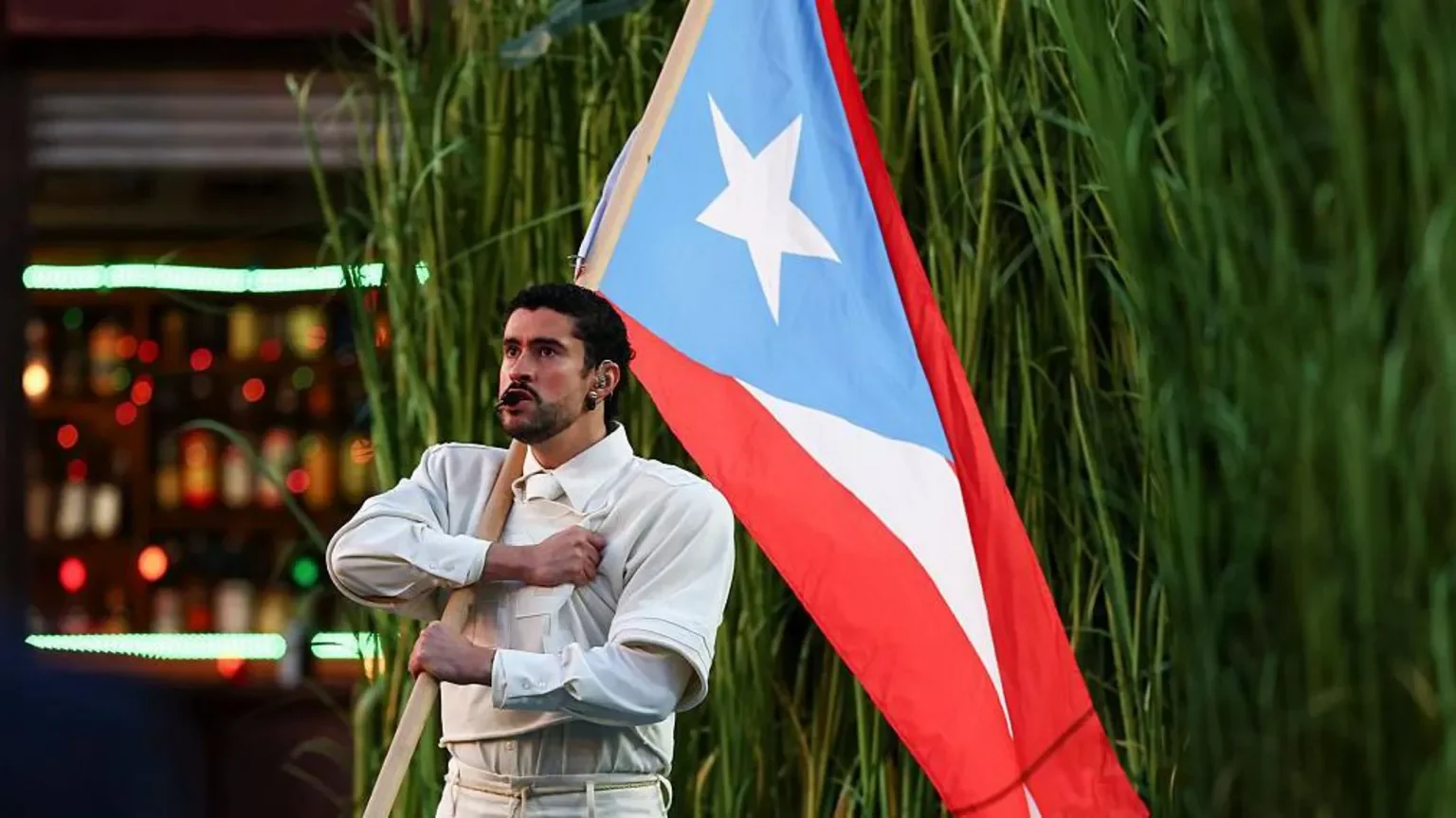
A photograph of ‘Bad Bunny’ carrying the Puerto Rican independence flag during Super Bowl LX’s halftime show (BBC Photo/Getty Images).
By Nicholas Vickery ‘26
As a Massachusetts native, I was naturally saddened by the Patriots’ performance in this year’s Super Bowl. I was, however, seized with greater disappointment upon watching the halftime show performed by Antonio Martínez Ocasio, known as ‘Bad Bunny.’ This sentiment—motivated not by the show’s quality, for indeed the production value was quite impressive—arose from the performance’s politicizing effect. As I will argue, this year’s halftime show featured clearly unpatriotic attributes. It did not exhibit, as it should have, a love of and gratitude for our nation. The Super Bowl is one of our country’s hallmark cultural events; it is, or at least used to be, a distinctively American attraction. Amidst an era characterized by polarization and tragically low American pride, such a widely viewed event has the power to push the U.S. toward unity, but Martínez fumbled this opportunity.
As I have already hinted, there were aspects of the performance that I appreciated, namely the high production quality and the real wedding that was celebrated halfway through. Yet, the sense of unity created by the inclusion of a wedding was soon marred by a politically charged claim of unity. Toward the end, Martínez said the only English words of his performance: "God bless America." These words alone would be quite appropriate and should be expected from any patriotic U.S. citizen; after all, this phrase has been embedded in American culture since it was coined during World War I and popularized in the lead-up to World War II as an expression of U.S. patriotism. Martínez, though, exploited this phrase to redefine “America” by listing every country in North and South America.
I am aware that many in the Western hemisphere challenge, perhaps understandably, the notion that the adjective “American” belongs only to those from the United States. While there is merit to the various semantic arguments surrounding this word, Martínez’s decision to end his performance with such a proposition is inappropriate, especially given it was articulated in a context where we should be celebrating our nation. It implies that there is nothing special about our nation—that we are just one of many. Some may argue that it was a celebration of diversity and, specifically, Latin American culture in the United States. They may point to the invitation and presence of renowned Puerto Rican business owner Toñita. Though the performance was quite clearly a celebration of Latin American culture, his redefinition of “America” indicates it was a celebration of Puerto Rican culture and diversity in the Americas, not particularly the U.S.A.
Another apt refutation of this idea that he was celebrating diversity within the United States was his unpatriotic use of the Puerto Rican independence flag during the performance, which features a light blue triangle instead of the official dark blue color. This version of the flag has long been associated with a movement aimed primarily at separating Puerto Rico from what it views to be an exploitative relationship with the U.S. The Super Bowl halftime show, an integral part of a unique sporting event in the U.S., should be a celebration of our national culture. It should affirm that our nation is indeed special and worthy of patriotism, not shame America for its expansionist history as Martínez did.
The performance should also aim to bring our not-so-united fifty states closer amidst a climate of political polarization. The selection of ‘Bad Bunny’—a choice made jointly by the National Football League (NFL) and Jay-Z’s entertainment company Roc Nation to boost international viewership—seems, at the very least, a poor choice given his politically controversial history and perhaps even a political statement by the NFL. Martínez has been a vocal critic of the Trump administration and Immigration and Customs Enforcement (ICE) operations. In fact, during his Grammy Awards speech, he announced, “Before I say thanks to God, I'm going to say ICE out.” After applause from the audience, he continued his criticism of the Trump administration’s immigration policy, declaring, “We’re not savages, we’re not animals, we’re not aliens—we’re humans.” In what may be interpreted as a similar vein of thought, Martínez displayed the following words on the stadium screen: “The only thing more powerful than hate is love.” Some have argued that this implicit criticism of current immigration policy is a push for love and, through it, unity. On its face, the sentence is similar in spirit to the idea of unity, yet the very fact of it being an indirect labeling of Trump’s policy as “hate” exacerbates political division.
If his Grammy speech was his only publicly polemical statement in recent years, the choice of ‘Bad Bunny’ would be less problematic. Martínez, however, has a long history of political commentary. Months prior to the Super Bowl, he released a music video for “NUEVAYoL,” which contained two conspicuously controversial moments. The first featured the same Puerto Rican independence flag used in the halftime show hanging from the top of the Statue of Liberty, and the second was an audio clip mimicking President Trump to convey an apology message to immigrants. Neither of these political statements comes as a surprise. In 2024, Martínez publicly endorsed Juan Dalmau for governor of Puerto Rico, a third-party candidate with strong ties to the territory’s independence movement. His criticisms of Trump could also have been anticipated in light of his 2024 endorsement of Kamala Harris.
Regardless of where you fall on the political spectrum and of your opinion on ‘Bad Bunny’s’ music, the selection of such a politically controversial artist for one of the U.S.’s most iconic cultural events was undeniably a divisive one. At worst, the performance was inflammatory, and at best, it sacrificed a golden opportunity to unite a polarized nation. Instead of exemplifying gratitude and pride to be an American, Martínez reduced the United States to a mere part of a larger continental whole and subtly called for Puerto Rican independence. It was a truly unpatriotic performance.
I sincerely hope that next year’s halftime performance reverses course and reflects the themes of American unity and pride that our great nation deserves.