"No Longer A Virtuous Nation": Trump, Putin and International Law
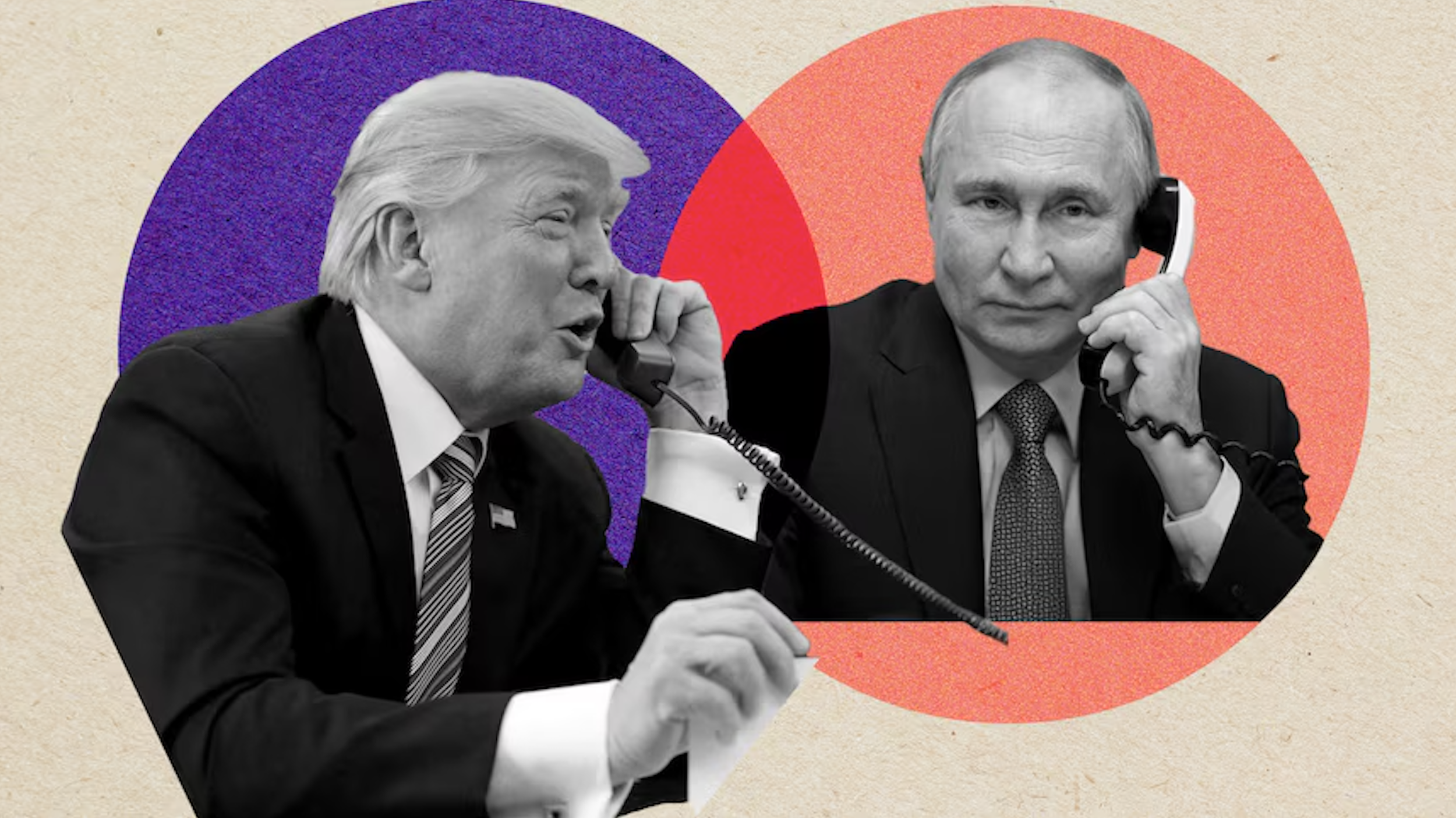
Image from ABC News Graphics by Kylie Silvester.
By Louis René Beres (Ph.D., Princeton, 1971)
Emeritus Professor of International Law
Purdue University
lberes@purdue.edu
“There is no longer a virtuous nation, and the best of us live by candlelight.”
-William Butler Yeats
The Irish poet was prophetic. Though European states generally stand virtuously with Ukraine, U.S. President Donald J. Trump still seems more eager to gain Vladimir Putin’s personal approval than to serve law-based policies. In a reductio ad absurdum of US Constitutional expectations, Trump’s openly un-American preference includes sacrificing the lives of Ukrainian children targeted by Russian aggression.[1]
Things are not getting any better. The range and intensity of Russia’s crimes have not been reduced after the February 2026 Geneva conference.[2] Instead, these unhidden crimes are being expanded. For President Trump, the solution is not justice, but “reaching a deal.”
But what is pertinent law on grievous Russian transgressions against Ukraine? From the standpoint of international law, which is part of United States law,[3] Russia’s war against Ukraine should be defined as a “crime scene” as well as a military contest. Ipso facto, the American president has no legal grounds to call for Ukrainian territorial concessions. Multiple acts of aggression[4] are being carried out solely by Russia (owing to singular Trump-administration emphasis on “getting a deal”) and with evident impunity. In such matters, the only law-enforcing expectations for a “virtuous nation” should be (1) an immediate return to status quo ante bellum; and (2) an enforceable schedule of reparations to the victim state by the aggressor state.[5]
Under law, justice is never subservient to politics. When Donald J. Trump proposes that Russia and Ukraine “swap territories,” he is advocating egregious violations of international law and United States law. This is not an arguable point.
Vladimir Putin acquired Ukrainian territories only by committing overt acts of aggression; he has no conceivable legal right to keep them.[6] If Trump-engineered diplomacy rewards Putin’s crimes with a surrender of stolen Ukrainian lands, the US president would also be accessory to unpardonable crimes. Even the United States as a whole - as the delinquent sovereignty - would be complicit in “denials of justice.”[7]
There is more. Trump’s de facto acceptance of Russian crimes amounts to a serious dereliction under American domestic law. More specifically, it renders the United States complicit in crimes against peace (aggression), crimes of war (humanitarian international law)[8] and crimes against humanity[9] (genocide).[10]
In all these matters, history deserves pride of place. Continuously, Donald J. Trump has been urging surrender policies identical to British Prime Minister Neville Chamberlin’s 1938 declaration of “peace in our time.” On its face, Trump’s prospective “settlement” of a war created by Russian aggression represents a woeful re-play of 1938 Munich and its capitulations to Third Reich aggression.[11] Inter alia, any such settlement would violate Principle 1 of the 1950 Nuremberg Principles[12] and every imaginable expectation (both codified and customary) of global justice.
Even in our state-based system of international law—the sovereignty-centered system first brought into being at the Peace of Westphalia in 1648[13]—a presumption of global solidarity overrides all presumed prerogatives of sovereignty. Especially after strong legal expectations embodied at the post-World War II Nuremberg Judgment and Principles, states have not only the right but also the obligation to act in support of territorial sovereignty and national independence. Derivatively, states are obligated to reject claims of “just war” made in defense of acts of aggression.
The grievous harms that Russia continues to inflict on Ukraine (noncombatants as well as combatants) represent crimes of “international concern.” It follows, among other things, that every state member of the community of nations has an irreducible obligation to stand against the aggressor state and alongside the victim state.
Acting against the victim state’s right to seek membership in a willing collective self-defense organization (here, NATO) contravenes both the spirit and the letter of authoritative international law. Scholars and policy-makers can find ample support for this imperative in classical legal writings of Cicero, Hugo Grotius, Samuel Pufendorf and Emmerich de Vattel. Though such names will appear unrecognizable to laypersons, even the US president and his principal advisors, they were already well known to Founding Fathers of the United States.
Transmitted into US law in the 18th century by William Blackstone’s Commentaries on the Laws of England—learned observations that represent the beginnings of United States law—these observations on justice were imbued with philosophies of “natural law.”[14] For Donald J. Trump, prima facie, natural law origins of United States law have never been recognized or understood. Nonetheless, among codified or otherwise “positive” rules, these origins now call for a (1) prompt and uncompromised rejection of Russia’s territorial claims against Ukraine; and (2) correlative prosecution of Vladimir Putin by the International Criminal Court or other national, international or ad hoc tribunal of determinedly competent jurisdiction. For the present, of course, there is no chance that the US president would follow the law-based and virtuous course.
There are basic sources to consult. To wit, interested scholars and policy makers alike could examine Book 2 of Emmerich de Vattel’s encyclopedic The Law of Nations (1758): Says Vattel: “If there should ever be found a restless and unprincipled nation, every ready to do harm to others, to thwart their purposes and to stir up civil strife among their citizens, there is no doubt that all other states would have the right to unite together to subdue such a nation, to discipline it, and even to disable it from doing further harm.”
In law, truth is exculpatory. Donald J. Trump’s “open-mindedness” on Russian crimes falls short of his sworn obligations under both US law and international law.[15] If there should still remain any doubters regarding this intolerable shortfall, they would need only to remember the language of the UN’s Statute of the International Court of Justice. Article 38 of this foundational (1945) document describes “the general principles of law recognized by civilized nations” as a primary source of international law.
Gabriela Mistral, the Chilean poet who won the Nobel Prize for literature in 1945, opines that crimes against humanity carry within themselves “a moral judgment over an evil in which every feeling man and woman concurs.” In his expected silence on “moral judgment” for Putin crimes, Donald J. Trump seems certain to ignore his overlapping obligations under U.S. law and international law. If there should still remain any “realists” who refuse to acknowledge the need to condemn such an insidious silence, they ought to look back over the doctrinal foundations of all authoritative jurisprudence.
There is more. International law includes norms of a customary as well as codified nature. Article 38(1)(b) of the Statute of the International Court of Justice describes international custom as "evidence of a general practice accepted as law." The norms of customary international law bind all states, irrespective of whether it has ratified the relevant instrument of codification.
International law compartmentalizes apparently identical rights and obligations arising out of customary law and treaty law: "Even if two norms belonging to two sources of international law appear identical in content, and even if the states in question are bound by these rules both on the level of treaty-law and on that of customary international law, these norms retain a separate existence."[16]
In summation, even after its willful February 2026 failures in Geneva, the United States has a responsibility to stand reliably against the Nuremberg-category crimes being committed by Russia against Ukraine. In an optimally gainful scenario, though one unlikely to resonate with a US president who habitually fawns before his Russian counterpart,[17] Donald J. Trump would affirm America’s non-negotiable support of Ukraine’s territorial sovereignty and national independence. In so doing, the United States could still reclaim its original status as a “virtuous nation,” and a “nation of laws”[18] might no longer have to “live by candlelight.”
Though plausibly not his intent, William Butler Yeats, the Irish poet, was prophetic about world politics. In terms of international law and United States law, it is now America’s unchallengeable responsibility to prove his prophecy wrong in regard to Russian-battered Ukraine. In essence, under no conceivable circumstances could it be legal for an American president to demand territorial and other concessions from a peace-abiding state being victimized by multiple acts of aggression.
[1] On aggression as a specific crime under international law, see RESOLUTION ON THE DEFINITION OF AGGRESSION, Dec. 14, 1974, U.N.G.A. Res. 3314 (XXIX), 29 U.N. GAOR, Supp. (No. 31) 142, U.N. Doc. A/9631, 1975, reprinted in 13 I.L.M. 710, 1974; and CHARTER OF THE UNITED NATIONS, Art. 51. Done at San Francisco, June 26, 1945. Entered into force for the United States, Oct. 24, 1945, 59 Stat. 1031, T.S. No. 993, Bevans 1153, 1976, Y.B.U.N. 1043.
[2] The meetings were held by the United States, Russia and Ukraine on February 17 and 18 2026 in Geneva, Switzerland.
[3] In words used by the U.S. Supreme Court in The Paquete Habana, "International law is part of our law, and must be ascertained by the courts of justice of appropriate jurisdiction, as often as questions of right depending upon it are duly presented for their determination. For this purpose, where there is no treaty, and no controlling executive or legislative act or judicial decision, resort must be had to the customs and usages of civilized nations." See The Paquete Habana, 175 U.S. 677, 678-79 (1900). See also: The Lola, 175 U.S. 677 (1900); Tel-Oren v. Libyan Arab Republic, 726 F. 2d 774, 781, 788 (D.C. Cir. 1984) (per curiam) (Edwards, J. concurring) (dismissing the action, but making several references to domestic jurisdiction over extraterritorial offenses), cert. denied, 470 U.S. 1003 (1985) ("concept of extraordinary judicial jurisdiction over acts in violation of significant international standards...embodied in the principle of `universal violations of international law.'").
[4] Following the Kellogg-Briand Pact (1928) and the United Nations Charter (1945), there remains no legal right to wage an aggressive war. However, the long-standing customary right of post-attack self-defense does remain codified at Article 51 of the UN Charter. Similarly, subject to conformance, inter alia, with jus in bello criteria, certain instances of humanitarian intervention and collective security operations may also be consistent with jus ad bellum standards. The law of war, the rules of jus in bello, comprise: (1) laws on weapons; (2) laws on warfare; and (3) humanitarian rules. Codified primarily at The Hague and Geneva Conventions, these rules attempt to bring distinction, proportionality and military necessity into all belligerent calculations.
[5] Under international law, Russia’s verifiable kidnapping of approximately 20,000 Ukrainian children is an act of genocide.
[6] In law, Putin’s responsibility for Russian crimes against Ukraine is not limited by his official position or lack of direct personal action. On the principle of command responsibility, or respondeat superior, see: In re Yamashita, 327 U.S. 1 (1945); The High Command Case (The Trial of Wilhelm von Leeb) 12 LAW REPORTS OF TRIALS OF WAR CRIMINALS 1, 71 (United Nations War Crimes Commission Comp. 1949); see: Parks, COMMAND RESPONSIBILITY FOR WAR CRIMES, 62 MIL.L.REV. 1 (1973); O'Brien, THE LAW OF WAR, COMMAND RESPONSIBILITY AND VIETNAM, 60 GEO.L.J. 605 (1972); U.S. DEPT OF THE ARMY, ARMY SUBJECT SCHEDULE No. 27 - 1 (Geneva Conventions of 1949 and Hague Convention No. IV of 1907) 10 (1970). The direct individual responsibility of leaders for crime s of war, genocide and genocide-like crimes is unambiguous in view of the London Agreement, which denies defendants the protection of the Act of State defense. See AGREEMENT FOR THE PROSECUTION AND PUNISHMENT OF THE MAJOR WAR CRIMINALS OF THE EUROPEAN AXIS, Aug. 8, 1945, 59 Strat. 1544, E.A.S. No. 472, 82 U.N.T.S. 279, Art. 7. Under traditional international law, violations were the responsibility of the state, as a corporate actor, and not of individual human decision-makers in government or the military. Today, even if Putin could somehow argue persuasively that Russian military violations in Ukraine were being committed without his express authorization, he would remain legally responsible.
[7] Though international law does not specifically advise particular penalties or sanctions for states that choose not to prevent or punish genocide committed by others, all states, notably the “major powers” belonging to the UN Security Council, are bound, among other things, by the peremptory obligation (defined at Article 26 of the Vienna Convention on the Law of Treaties) known as pacta sunt servanda, to act in continuous “good faith.” In turn, this pacta sunt servanda obligation is derived from an even more basic norm of world law. Known commonly as “mutual assistance,” this civilizing norm was most famously identified within the classical interstices of international jurisprudence, most notably by eighteenth-century legal scholar, Emmerich de Vattel, in The Law of Nations (1758).
[8] Humanitarian international law, or the laws of war, comprise: (1) laws on weapons; (2) laws on warfare; and (3) humanitarian rules. Codified primarily at The Hague and Geneva Conventions, and known thereby as the law of The Hague and the law of Geneva, these rules seek to bring discrimination, proportionality and military necessity into belligerent calculations. On the main corpus of jus in bello, see: Convention No. IV, Respecting the Laws and Customs of War on Land, With Annex of Regulations, Oct. 18, 1907, 36 Stat. 2277, T.S. No. 539, 1 Bevans 631 (known commonly as the "Hague Regulations"); Convention for the Amelioration of the Condition of the Wounded and Sick in Armed Forces in the Field, Aug. 12, 1949, 6 U.S.T. 3114, T.I.A.S. No. 3362, 75 U.N.T.S. 85; Convention Relative to the Treatment of Prisoners of War, Aug. 12, 1949, 6 U.S.T. 3316, T.I.A.S. No. 3364, 75 U.N.T.S. 135; Convention Relative to the Protection of Civilian Persons in Time of War, Aug. 12, 1949, 6 U.S.T. 3516, T.I.A.S. No. 3365, 75 U.N.T.S. 287.
[9] Crimes against humanity are defined as "murder, extermination, enslavement, deportation, and other inhumane acts committed against any civilian population before or during a war; or persecutions on political, racial or religious grounds in execution of or in connection with any crime within the jurisdiction of the Tribunal, whether or not in violation of the domestic law of the country where perpetrated...." Charter of the International Military Tribunal, Aug. 8, 1945, Art. 6(c), 59 Stat. 1544, 1547, 82 U.N.T.S. 279, 288.
[10] Neither international law nor US law specifically advises any particular penalties or sanctions for states that choose not to prevent or punish genocide committed by others. Nonetheless, all states, most notably the "major powers" belonging to the UN Security Council, are bound, among other things, by the peremptory obligation (defined at Article 26 of the Vienna Convention on the Law of Treaties) known as pacta sunt servanda, to act in continuous "good faith." In turn, this pacta sunt servanda obligation is itself derived from an even more basic norm of world law. Commonly known as "mutual assistance," this civilizing norm was most famously identified within the classical interstices of international jurisprudence, most notably by the eighteenth-century legal scholar, Emmerich de Vattel in The Law of Nations (1758).
[11] See AGREEMENT FOR THE PROSECUTION AND PUNISHMENT OF THE MAJOR WAR CRIMINALS OF THE EUROPEAN AXIS POWERS AND CHARTER OF THE INTERNATIONAL MILITARY TRIBUNAL. Done at London, August 8, 1945. Entered into force, August 8, 1945. For the United States, Sept. 10, 1945. 59 Stat. 1544, 82 U.N.T.S. 279. The principles of international law recognized by the Charter of the Nuremberg Tribunal and the judgment of the Tribunal were affirmed by the U.N. General Assembly as AFFIRMATION OF THE PRINCIPLES OF INTERNATIONAL LAW RECOGNIZED BY THE CHARTER OF THE NUREMBERG TRIBUNAL. Adopted by the U.N. General Assembly, Dec. 11, 1946. U.N.G.A. Res. 95 (I), U.N. Doc. A/236 (1946), at 1144. This AFFIRMATION OF THE PRINCIPLES OF INTERNATIONAL LAW RECOGNIZED BY THE CHARTER OF THE NUREMBERG TRIBUNAL (1946) was followed by General Assembly Resolution 177 (II), adopted November 21, 1947, directing the U.N. International Law Commission to "(a) Formulate the principles of international law recognized in the Charter of the Nuremberg Tribunal and in the judgment of the Tribunal, and (b) Prepare a draft code of offenses against the peace and security of mankind...." (See U.N. Doc. A/519, p. 112). The principles formulated are known as the PRINCIPLES OF INTERNATIONAL LAW RECOGNIZED IN THE CHARTER AND JUDGMENT OF THE NUREMBERG TRIBUNAL. Report of the International Law Commission, 2nd session, 1950, U.N. G.A.O.R. 5th session, Supp. No. 12, A/1316, p. 11.
[12] See Principles of International Law Recognized in the Charter of the Nuremberg Tribunal and in the Judgment of the Tribunal; 2 August 1950.
[13] International law remains a "Westphalian" system. See: Treaty of Peace of Munster, Oct. 1648, 1 Consol. T.S. 271; and Treaty of Peace of Osnabruck, Oct. 1648, 1., Consol. T.S. 119, Together, these two treaties comprise the Peace of Westphalia.
[14] Under international law, the idea of Natural or Higher Law - drawn originally from the philosophic writings of ancient Greeks and ancient Hebrews - is contained, inter alia, within the principle of jus cogens or "peremptory" norms. According to Article 53 of the Vienna Convention on the Law of Treaties: “…a peremptory norm of general international law is a norm accepted and recognized by the international community of states as a whole as a norm from which no derogation is permitted and which can be modified only by a subsequent norm of general international law having the same character.” See: Vienna Convention on the Law of Treaties, Done at Vienna, May 23, 1969. Entered into force, Jan. 27, 1980. U.N. Doc. A/CONF. 39/27 at 289 (1969), 1155 U.N.T.S. 331, reprinted in 8 I.L.M. 679 (1969).
[15] Incomprehensibly, after taking the oath of presidential office twice, Donald Trump says that he doesn’t know if he needs to uphold the Constitution: https://www.politico.com/news/2025/05/04/i-dont-know-trump-constitution-00326040
[16] See Military and Paramilitary Activities (Nicaragua v. U.S.), 1986 I.C.J. Rep. 14, para. 178 (June 27).
[17] One may think here of Hermann Hesse’s generic definition of the false leader in The Glass Bead Game (1943): “The dull-witted brute, blindly trampling around in the flower gardens of intellect and culture.”
[18] See by this writer, Louis René Beres, at Modern Diplomacy (2025): https://moderndiplomacy.eu/2025/03/03/a-government-of-laws-not-if-trump-continues-to-support-putin-crimes-against-ukraine/
Louis René Beres was educated at Princeton (Ph.D., International Law, 1971). He is Emeritus Professor of International Law at Purdue University. Dr. Beres has published at The New York Times; The Atlantic; The Bulletin of the Atomic Scientists; Harvard National Security Journal (Harvard Law School); The Hill; World Politics (Princeton); Princeton Political Review; International Security (Harvard); American Journal of International Law; JURIST; Yale Global; BESA (Israel); Oxford Annual Yearbook on International Law and Jurisprudence (Oxford University Press) and several dozen major law journals. He also publishes widely in principal journals of the US Army and US Air Force. Professor Louis René Beres was born in Zürich at the end of World War II.