The EU’s North-South Divide: How the Tables Have Turned
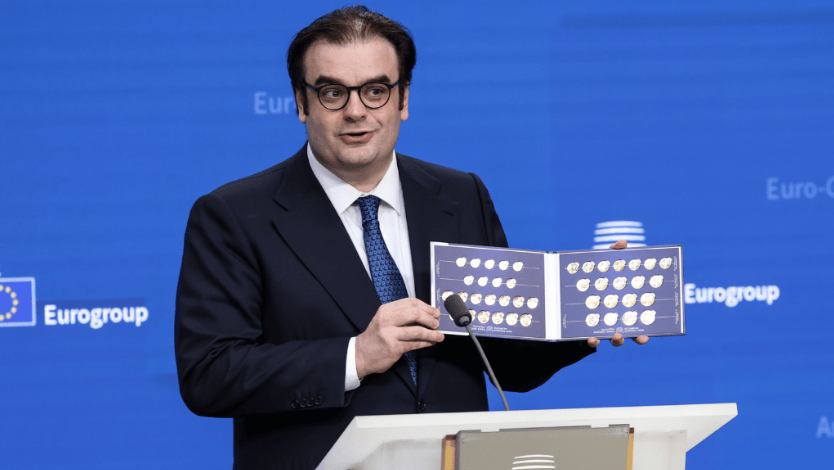
The new President of the Eurogroup, a convention of European finance ministers, Kyriakos Pierrakakis – a Greek (Image from The European Council)
By Olia Artinian ‘29
It was with hastened pace, restless eyes, and a composed demeanor that the Prime Minister of France Sébastien Lecornu rose to the podium before the press. After a solemn greeting, the troubled man proceeded to articulate the fatal words: “I am submitting the resignation of my government”.
Just 27 days in office and barely 12 hours after the appointment of his cabinet, the beleaguered politician became the fifth Premier to step down in a space of less than two years (only to be reappointed four days afterwards). A looming budgetary crisis, a polarized electorate, and the proliferation of extremist, populist agendas brought down the curtains of yet another European government.
In the past, such events used to be the exclusive right of Athens’s Vouli or Madrid’s Cortes Generales – both of which are infamous for their long record of politico-economic instability. Paris’s lavish Hôtel de Matignon, for years looked upon as a bastion of the European establishment, therefore, constitutes a strange addition to the club.
Since the end of the Covid-19 pandemic, a curious trend has arisen in European politics: the so-called prudent Northern and Central European Union (EU) nations such as France, Germany, and Finland have been experiencing economic and political decline. Meanwhile their “irresponsible” Southern counterparts – Greece, Spain, and to a lesser extent Italy – have undergone profound economic, political, and societal growth. This is a moment of catharsis for the Mediterranean region which, for almost a decade, endured harsh austerity measures imposed by their very “thoughtful” and “understanding” Northern neighbors who cared little about the economic survival of the Greeks, Spanish, and Italians if that meant defending Germany’s financial status.
But what are the factors behind this tendency and what its implications for Brussels and beyond? Shifting global economic realities are largely responsible for this trend, however, state-led initiatives and institutional empowerment also have a prominent role to play, putting Southern Europe back on the map.
PIGS: a dirty background
In 2008, the world was sent reeling from the aftermath of the global financial crisis. A housing bubble characterized by unsustainably high real-estate prices had just burst, sending American and European stock markets into freefall. Once generous creditors were now becoming more reticent, carefully selecting where to put their money, even avoiding medium-risk markets.
These developments boded ill for Europe’s southernmost economies, which had been accumulating debt to unsustainable levels. By 2010, Greece’s debt had reached a staggering 147.8% of GDP, Italy’s 118.8%, and Portugal’s 100.1% – figures that would make any rational investor run for their life. And run, they did. National reserves and government coffers started to run dry, resulting in underfunded public services and unpaid creditors. Southern Europe was on the brink of bankruptcy. It was not just a national debt crisis for the implicated countries, but an economic catastrophe for Europe as a whole.
A couple of years ago, on January 1st, 1999, the euro was launched, creating a shared currency for all Eurozone members, including the Southern European nations. However, this economic relationship went deeper than common, colorful banknotes. In practice, it meant that Berlin’s and Amsterdam’s economic prospects became intertwined with Rome’s and Madrid’s. Hence, if were Greece to declare insolvency, the fiscal crisis would metastasize to the rest of the Eurozone, a scenario which prompted the Old Continent’s “core” countries (read: North) to impose harsh austerity measures on the “periphery” (read: South) to reign in the situation – euphemism for saving their own pockets.
Unemployment, brain drain, and failing public services became characteristic symbols of Southern Europe throughout the 2010s. Ghost-like urban formations or “ciudades fantasma” devoid of dynamism, haunted Spain as construction projects were abandoned. Populism and public protests became the norm in domestic politics, causing further ruptures with the European establishment, as the Grexit (Greece’s potential exit from the Eurozone) close call highlights.
Of course, like the empathizing partners that they are, Northern and Central European capitals rushed to console their tormented Southern counterparts by giving them the nickname PIGS (Portugal, Italy, Greece, Spain). In a show of reciprocity, Madrid and Athens used equally tender words to describe then German Chancellor Ms. Merkel, creating the EU North-South divide.
Karma is a BBB+
To clarify, Southern Europe is still trailing behind Central and Northern European capitals in absolute terms. Greece’s credit rating (a measurement of how reliable a country is to repay its debt) is still BBB compared to Germany’s AAA. Italy’s GDP per capita in 2024 amounted to 32,880 euros, a far cry from Finland’s 43,110 euros.
Where Mediterranean nations are leading the way is in relative terms – that is, growth rate. Even amidst a volatile global geopolitical environment, Spain’s economy saw a 3.5% increase in 2024, a markedly better performance when compared to Germany’s economic contraction of -0.5%, for example.
A common interpretation of these figures postulates that this phenomenon is only natural: Southern European economies are expected to experience a rapid, upward projectile since they started from a much lower base compared to their Northern neighbors. However, this ignores the tangible, qualitative progress that has reshaped and strengthened their institutions and decision-making. Solely focusing on indices and numbers risks overshadowing the real economic, political, and social recuperation of the once infamous “sick men of Europe”.
Wirtschaftswunder alla Mediterranea
Structurally, southern European economies are heavily reliant on tourism – an industry that was dealt a severe blow by the Covid-19 pandemic. Nonetheless, this economic concentration turned out to be a useful asset, rendering them eligible to claim a huge share of the NextGenerationEU stimulus package, a European Union-sponsored recovery plan designed to support member states’ post-pandemic recovery. Spain and Italy were by far the biggest beneficiaries, with their grants amounting to 77.23 and 69.04 billion euros, respectively. Thus, they were given fiscal space to better manage their debt obligations and cater to their public services.
Of course, recovery funds alone would be meaningless had they not been accompanied by smart fiscal policies and prudent borrowing. The economic restructuring that southern Europe underwent during the 2010s, though painful, helped replace previous irresponsible attitudes. In 2011, Madrid agreed to amend its constitution (Section 135) to comply with EU structural deficit limits and now intends to reach a budget deficit of 2.1% this year (excluding recovery funds for flood-stricken Valencia). Contrast this with France, which in 2023 had a 5.5% deficit, provoking an Excessive Deficit Procedure (EDP) by the European Council. Nicolas Sarkozy, the former President of France, has held back since then.
Southern Europe is also much less reliant on Russian energy supplies. In contrast, Germany, for example, imported 55% of its gas from Moscow prior to the invasion of Ukraine. Hence, the impact of EU sanctions on Russian oil was not as profound in the South as in the North. Moreover, Southern countries were transformed into “energy hubs”, with the notable example being Greece, which recently sealed a deal to supply Central and Eastern Europe, as well as Ukraine, with American liquified natural gas (LNG). Though this carries its own risks, it is evident that the economy of Southern Europe is flourishing at a time when the “core” is struggling.
Despite still lagging behind in absolute terms, the “periphery”, knowing how to endure challenging economic situations due to its recent experience, acts as a bastion of stability amidst a shifting politico-economic landscape, tainted by the Hormuz straits crisis and an unpredictable US trade policy. Northern Europe, on the other hand, suffers much more profoundly by these successive calamities due to years of complacency and overreliance on unpredictable partners such as Russia, and most recently the Gulf and the United States.
This may as well be the beginning of an economic miracle tantamount to the “Wirtschaftswunder” – (West) Germany’s profound economic development following World War II – however with a pinch of Mediterranean spice.
From Ostpolitik to Südpolitik
Southern Europe has proved particularly immune to extremism, the modern-day plague which manifests itself through different variants across Northern and Central Europe, from Germany’s AfD party to the French Rasseblement National. This is largely because of recent experiences: prior to and during the Eurozone crisis these Southern countries fell prey to demagoguery and empty rhetoric. Citizens, however, fell out of favor with these parties, upon realizing that such leaders offered nothing but hollow words, which, in many cases, could have adverse effects for their country’s wellbeing. Notably, the hard-left former Greek Prime Minister Alexis Tsipras had to succumb to EU pressures, accepting a third bailout, when he had previously asserted that “we [Greeks] will beat the drums and [the markets] will be dancing”. With the wounds still wide open, Southern Europeans prefer to cast their ballots for centrist, mainstream parties rather than anti-establishment polemics. Even the far-right Italian premier Giorgia Meloni has positioned herself as a “good European”.
In foreign affairs, the Trump phenomenon appears to disproportionately affect the core of the European establishment – France, Germany, and Denmark – rather than the peripheral Greece, Italy, Spain, or Portugal. From threats to annex Greenland to the mocking remarks about Macron’s “beautiful sunglasses”, the Trump administration has consistently targeted the European elite, leaving the more underrepresented Southern states unscathed and able to carve their own independent path. Indeed, Spanish Prime Minister Pedro Sánchez has been able to resist Trump’s call for increased defense spending, and even criticize America’s endeavors in Venezuela without provoking such harsh retaliation by Washington (despite a recent row with the White House over the use of Spanish military bases to strike Iran). Meloni, owing to her shared values with the MAGA movement, has proved herself a key “linchpin” in US-EU affairs.
At last, Europe’s power balances seem to be shifting with the South presenting itself as a more stable alternative to the volatile political situation observed up North. Just like Cold War West Germany’s Ostpolitik policy, which aimed at alleviating tensions with the Eastern Bloc, Southern Europe’s Südpolitik version seeks to create a viable path forward, navigating increasingly uncertain geopolitical terrains.
The end of Mañana
Southern Europe has finally awakened from its decade-long siesta to realize and confront the 21st century realities that define the continent. Mañana, or the promise to act sometime in the indefinite future is now over.
While Berlin and Paris are busy appeasing an anti-migration electorate by curbing migratory inflows to their countries, Madrid has understood that migrants are not an existential menace to European purity, but a useful and vital economic asset for an aging continent, boosting workforce participation and thus sustaining increasing welfare state costs via taxation. More specifically, Spain recently launched an innovative plan aiming to regularize undocumented migrants and boost economic growth as those people shift from the parallel to the legal market. Of course, this should not overshadow the grave humanitarian tragedy that takes place routinely in the Mediterranean coast where a deplorable number of migrants lose their lives in search of a better future. Even though migration has recently become a scapegoat for Europe’s ills, at the very least, a rethinking to that approach is being led by one of the countries at the forefront of this massive crisis.
Innovation has also revamped the reputation of the European South. Athens launched a new program dubbed Greece 2.0 which seeks to digitalize and decrease the convoluted, bureaucratic hurdles that put brakes on entrepreneurship. Long queues, paperwork, and myriads of passwords have now been reduced to user-friendly apps that citizens can download on their phones. Germany’s Kafkaesque and dated bureaucracy could learn a thing or two.
That is not to say that Southern Europe is a paradise on Earth: corruption is still rife and a sprawling housing crisis is taking its toll, particularly among the youth. Over tourism is driving locals to the streets. That means that there is still a long way to go, but the first steps have been taken. The region which is tied together by common historical trends – from the rise of authoritarianism in the 30’s with Metaxas and Salazar, to the revolutions of the late 20th century, marked by the Years of Lead and the Athens Polytechnic Uprising – seems to be now marching, united, towards a new era of shared prosperity. Southern Europe, once the political, economic, and societal underdog of the Old continent, has now begun to rise to prominence.