Germany’s Five-Point Turn: How Immigration Politics Broke Postwar Solidarity
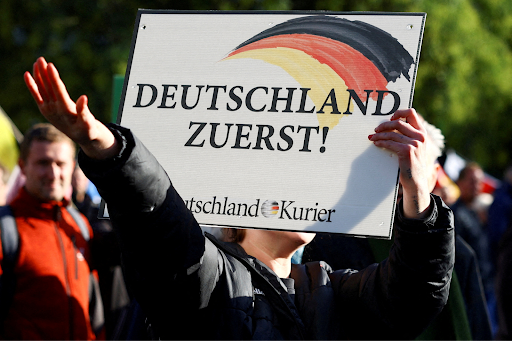
A photograph showing a protester holding a sign which reads “Germany First!” (Christian Mang/Reuters).
By Liam Hoffman ‘28
On January 29, 2025, the Christian Democratic Union (CDU), Germany’s center-right and now governing party, put forth what they call a “five-point plan” aimed at addressing immigration in the nation.This plan from Chancellor Friedrich Merz's party calls for policies like stronger border controls, even from other Schengen zone nations, and entry bans for rejected asylum seekers, and it signals a definite shift in popular rhetoric around immigration in Germany. In early 2025, immigration emerged as one of the central issues in the February German election, shifting from a topic focused on mainly by the far-right to one addressed by mainstream parties, as shown by the emergence of the “five-point plan.” This new, restrictive rhetoric around immigration is also indicative of a larger trend: an erosion of solidarity that marks a turning point for democratic norms in both Germany and Europe.
Postwar Foundations — Germany’s Long History of Solidarity
First, it is important to understand the history of immigration in modern, post-war Germany. Following the end of World War II, both West and East Germany had to adopt new self images that framed the nation in a different, more positive light. West Germany, lacking working age males, adopted guest worker programs that brought primarily Turkish immigrants into the nation in the thirty years following the war. These programs, sponsored by the government, were supported by a general solidarity across Germany, fueled by desires to adjust the nation’s image post World War II. This continued well into German reunification when the sentiment expanded, culminating in Angela Merkel’s 2015 open-door “Wir Schaffen Das” (“we can do this”) policy, which saw the nation bring in over one million refugees in just over a year. From the 1950s to 2015, Germany largely welcomed migrants in accordance with their carefully cultivated image. Yet, this sentiment shifted after 2015, sparking a new rightward shift which created the basis for the rhetoric of today.
The AfD’s Ascent and the Mainstream Response
For the first time, there was a significant public backlash against Germany’s immigration policy. For many, the policies of 2015 marked the decline of Merkel’s power and an end to the rhetoric that had allowed her to stay in power for so long. Before long, this lack of popularity manifested itself politically. The far-right Alternative for Germany party (AfD), which previously based its message on supporting Germany’s exit from the European Union, shifted its platform to become markedly anti-Merkel and, more importantly, anti-immigration. As the effects of Merkel’s 2015 immigration policies continued, the popularity of the AfD grew. By appealing to popular sentiment that Merkel’s coalition had placed the priorities of refugees over those of Germans, the AfD quickly gained ground, most notably in the former East. Now, the AfD sits as the most popular German political party with 26 percent of support nationwide as of August 2025. Still, mainstream parties refuse to work with the AfD, locking the party out of any coalition building efforts in what they call a “firewall”, essentially ensuring it will be unable to fill any positions of power. Despite this effort, the popularity of the AfD clearly frightens mainstream parties, who appear to be losing on the issue of immigration and have come together to develop plans for deportations and tighter border control that belonged only to the AfD for much of the last decade. Many worry the firewall has fallen, and parties in the center are starting to adopt the same policies they previously blocked from power.
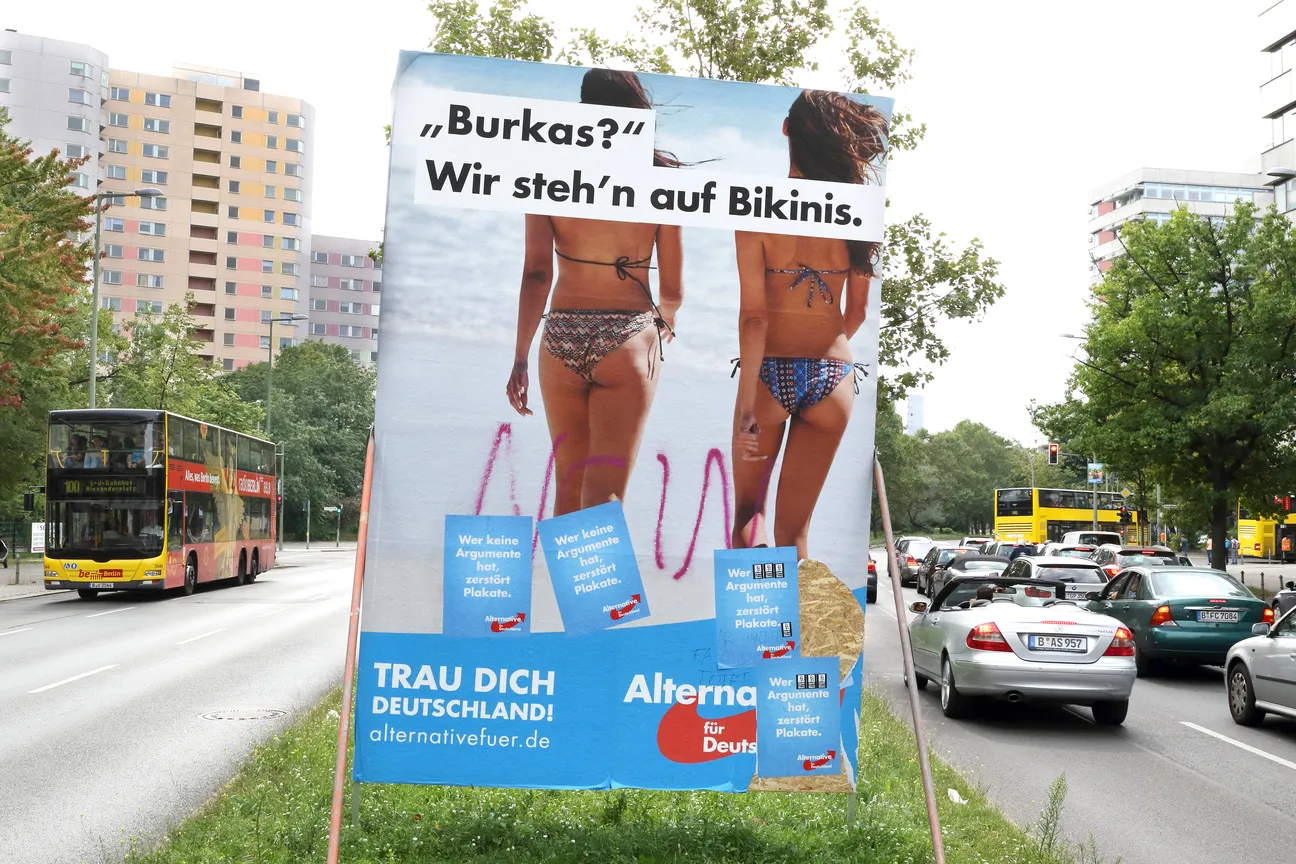
A photograph showing an anti-immigration AfD advertisement reads: “Burkas? We prefer bikinis." (Müller-Stauffenberg/Der Spiegel)
Economic Anxiety and Cultural Fractures
The change in rhetoric is clear: mainstream parties are adopting more anti-immigration approaches and heavily rolling back most open policies. What exactly has caused this shift? How has a country and the parties that govern it shifted their views on immigration so drastically, completely going against decades of rhetoric? Most would point to economic troubles. Germany has experienced a recession over the past three years, and economic slowdown has encouraged greater political instability. As the economy slowed, more Germans looked for a scapegoat and soon settled on the influx of refugees as the reason for the nation's economic downturn. However, experts continue to point to increased labor immigration as the answer to the nation’s economic problems. These calls continue to feed the anti-immigration rhetoric among the right, driving a divide between “elitist” think tanks who look towards more immigration as an answer, and the “common” German who is feeling the effects of a slowing economy. Even with evidence pointing towards immigration as a solution to rather than a cause of economic downturn, it’s easy to see how anxieties around a slowing economy are fueling an increase in anti-immigration rhetoric. Over the last year, centrist parties have started to adopt these views themselves, taking formerly far-right talking points and turning them into their own, in an effort to reclaim voters. With the majority of Germans supporting tighter immigration laws, it’s no surprise that populist parties would adopt these kinds of policies, but the implications for Germany, and Europe, are certainly worth noting.
Eroding Solidarity and the New Political Landscape
Within Germany, the rise of restrictive rhetoric around immigration normalizes exclusion and weakens the long standing centrist coalition. Germany’s political center has shifted rightwards, alienating those on the left. Although the center-right CDU and Christian Social Union in Bavaria (CSU) parties still actively work against the AfD at the policy level, the adoption of their rhetoric to appeal to their voters is a telling shift in German politics. This shift is felt outside of political stances as well, as immigrant communities in Germany report feeling less welcome amid these recent developments. Outside of Germany, these changes have also had an effect. With the AfD making it clear that they intend to oppose common European immigration policies, these changes threaten to affect Germany’s role within Europe as well. As this rhetoric becomes more popular in Germany, the development of tighter domestic immigration policies could lead to larger shifts in European solidarity around the issue, with the former leader of Europe's immigration movement also being the one that now threatens to help destroy it.
Looking forward, it is important to acknowledge the clear shift in Germany’s approach to immigration over the past year. What started as fringe, far-right rhetoric has quickly become that of the center, reversing long standing traditions of embracing immigration in Germany. The solidarity that once defined German policies is beginning to erode, and could come to define European politics as shifts like those in Germany are mirrored across the continent.