Gender, Power, and Conservatism: The Takaichi Administration’s Uncertain Future
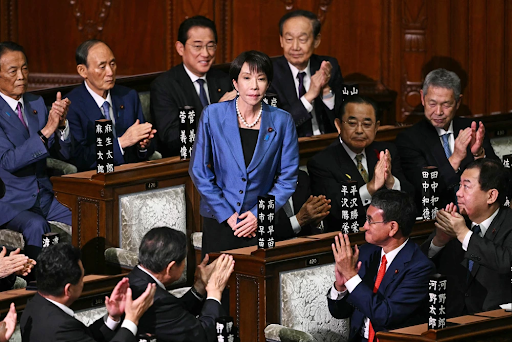
A photograph of Sanae Takaichi after she was elected as Japan’s new prime minister (Source: Philip Fong / AFP via Getty Images)
By Lily Noda ‘28
On October 4, Japanese politics reached a historic milestone when Sanae Takaichi became the first woman elected to lead the Liberal Democratic Party (LDP), the country’s ruling party. For a country ranking 118th out of 148 in the 2025 Global Gender Gap Report – the lowest among G7 nations – her rise marked a historic moment. On October 21, the National Diet formally appointed her as Japan’s first female prime minister.
This development is significant for Japan, a country that has historically elected only male leaders and whose political institutions remain overwhelmingly dominated by men. Incidentally, it may be tempting to view Takaichi’s victory as evidence of a broader shift toward a more progressive and gender-equal society.
Public opinion, however, particularly among feminists, has been far more ambivalent. Takaichi’s conservative ideology and skepticism toward feminist policy reforms have sparked debate over whether her leadership will advance or inhibit gender equality in Japan. While Takaichi's Cabinet has seen high public approval ratings, her support seems rooted not in her status as Japan’s first female leader, but in the political ideology she represents.
How Japan Elects Its Prime Minister
To understand how Takaichi came to power as the first female prime minister, it is important to briefly outline Japan’s parliamentary system. Members of the Diet – the national legislature – are elected to two chambers: the House of Representatives (lower house) and the House of Councillors (upper house). In this system, the prime minister is chosen by majority vote in the House of Representatives and is typically the leader of the party controlling the lower house majority. Once elected, the prime minister forms a Cabinet by appointing ministers who direct key government agencies and set national policy. That ruling party, almost without interruption since 1955, has been the Liberal Democratic Party (LDP), a right-leaning party that has dominated Japanese politics for decades.
Takaichi first joined the LDP in 1996 and entered the Cabinet under Prime Minister Shinzo Abe in 2006. A close ideological ally of Abe, she served as Minister for Internal Affairs and Communications during his second term in office. Following this role, she became the LDP’s Chairman of the Political Research Institute in 2012, and also served as the Minister of State for Economic Security under Prime Minister Kishida in 2022. She ran for LDP leadership three times: 2021, 2024 (with Abe’s endorsement), and finally 2025, when she secured the party presidency.
Although winning the LDP presidency positions a candidate as the party’s standard-bearer, it constitutes only the initial stage in becoming prime minister. Under Japan’s Constitution, the office is formally determined through a separate nomination vote held in both houses of the Diet. On October 21, the Diet convened to choose a successor to outgoing Prime Minister Shigeru Ishiba. Takaichi won a majority in the House of Representatives on the first ballot. In the House of Councillors, she fell one vote short of a majority in the first round, but then defeated Constitutional Democratic Party leader Yoshihiko Noda in the runoff.
Crucially, her victory came amid a shifting coalition landscape. After the Komeito party withdrew from its long-standing alliance with the LDP, the ruling party no longer held a majority in either chamber. To secure the premiership, the LDP reached a coalition agreement with the populist, center-right-wing Japan Innovation Party. Additionally, several independents signaled they would support her in the vote. These political maneuvers ensured that Takaichi was able to secure enough votes across both houses to win the nomination.
A Move Toward Greater Gender Equality?
Although Japan now has its first female prime minister, many question whether this milestone will translate into broader gender equality. Takaichi has long expressed admiration for Margaret Thatcher – Britain’s former Conservative Party leader and first female prime minister – and has positioned herself as Japan’s aspiring “Iron Lady.” This affinity reflects Takaichi’s own conservative orientation: she opposes same-sex marriage, supports maintaining male-only imperial succession, and rejects reforms that would allow married couples to retain separate surnames, an issue with significant implications for women’s autonomy.
Her Cabinet appointments reinforced this skepticism. Despite public expectations that she would elevate more women into leadership, Takaichi appointed only two female ministers: Satsuki Shoyama as Minister of Finance and Kimi Onoda as Minister of Economic Security, matching the number in the previous Ishiba Cabinet. When asked about the lack of female representation, Takaichi replied that she prioritizes equal opportunity and places “the right people in the right positions,” suggesting that gender parity is not a policy priority.
Observers have noted that Takaichi’s resistance to gender-focused rhetoric may have strengthened her appeal within the LDP. Former Diet member Kensuke Miyazaki noted that she frames her agenda as “for the people,” not “for women.” While this approach may limit her popularity among female voters, it has solidified her position within a party that remains deeply traditional and overwhelmingly male.
Implications for U.S.-Japan Relations and Beyond
Beyond domestic policy, Takaichi has signaled a willingness to pursue an assertive foreign policy agenda. Her views closely follow those of former Prime Minister Abe: strengthening the U.S.-Japan alliance, taking a harder line on China, and significantly expanding defense capabilities.
Within her first week as prime minister, she pledged to increase defense spending to 2% of GDP by spring 2026, thereby accelerating the previous timeline by two years.
On October 28, a week after Takaichi’s rise to power, she met U.S. President Donald Trump in Tokyo during his tour of East and Southeast Asia. She described their meeting as the start of “a new golden age of the Japan-U.S. alliance,” and Trump in turn called her “one of the great prime ministers.” She also announced Japan’s intention to nominate Trump for the Nobel Peace Prize, citing his efforts in the Middle East.
Furthermore, Takaichi’s assertiveness has already begun reshaping regional dynamics in East Asia. On November 7, during a Diet Budget Committee session, she suggested that a hypothetical Chinese attack on Taiwan could trigger a Japanese military response – a statement that escalated tensions with Beijing. China issued a strong rebuke, alleging that Japan had made “blatantly provocative remarks,” and subsequently, on November 14, released a travel advisory cautioning Chinese citizens against travel to Japan amid elevated political risk.
Looking Ahead — The Future of Japanese Politics
Takaichi’s ascent marks a notable rupture in Japan’s political trajectory, but it does not, on its own, signal a broader shift in the nation’s underlying ideological orientation. Her leadership encapsulates a tension at the core of contemporary Japanese politics: a symbolic milestone for gender representation juxtaposed with a policy agenda rooted in conservatism.
Domestically, debates over gender equality, constitutional reform, and the role of the state will likely intensify as her administration navigates public skepticism amid a fragmented political landscape. Internationally, her assertive foreign policy positions Japan as a more vocal regional actor, with implications for security alliances and geopolitical stability in East Asia and beyond.
Whether Takaichi’s tenure will catalyze deeper political transformation or reinforce the status quo remains uncertain, but her leadership has undeniably ushered Japan into a new and more contested political era.