Redefining “America First”: Donald Trump’s Foreign Policy Strategy
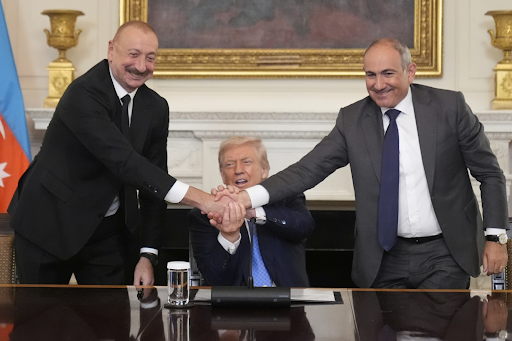
President Donald Trump, center, shakes hands with Armenian Prime Minister Nikol Pashinyan, right, and Azerbaijan President Ilham Aliyev during a trilateral signing ceremony in the State Dining Room of the White House, Friday, Aug. 8, 2025, in Washington. (AP Photo/Mark Schiefelbein)
By Ian Rosenzweig ’29
In the time leading up to the 2024 United States Presidential Election, some observers characterized Donald Trump’s foreign policy as isolationist, a term prominent in twentieth century interwar American politics that refers to withdrawal from foreign wars and alliances. Throughout his campaign, Trump voiced reservations about defending NATO allies that fail to meet prescribed defense spending benchmarks. His running mate expressed similar skepticism: Vice President JD Vance’s assertion that he “[doesn’t] really care what happens to Ukraine one way or another” was cited in coverage of his candidacy by The New York Times, Politico, and major outlets.
Meanwhile, a pre-election article in Foreign Policy by Josh Rudolph, the head of the German Marshall Fund's Transatlantic Democracy Working Group, argued, “It’s dangerously naive to view former U.S. President Donald Trump as simply another ‘isolationist’ whose foreign policy echoes nothing darker than Americans’ historical urges to pull back from the world.” He instead describes Trump as “pro-dictator.”
Almost one year into his second term, observers disagree over the best classification of President Trump’s foreign policy. Some, like Stephen Wertheim of the Quincy Institute for Responsible Statecraft and the Saltzman Institute of War and Peace Studies at Columbia University, describe Trump as “heterodox in thought and action.” But Trump’s attitude toward international relations is, at least in one respect, consistent with both the internal logic of his approach and the practices of prior administrations: a sustained commitment to American preeminence on the global stage.
In a sense, Trump’s “America First” platform can be understood as an extended form of a doctrine that seeks to assert American primacy in international affairs, shaping the behaviors of both allies and foes.
In October 2025, after the announcement of the ceasefire deal between Hamas and Israel, the State Department posted a graphic on X crediting the Trump Administration with ending eight wars (an amendment of a previous post naming seven conflicts). According to an Associated Press analysis, several of the cited conflicts were not actually wars, nor can the Trump Administration legitimately claim credit for brokering all eight resolutions.
The report notes that tension persists between the Democratic Republic of the Congo and Rwanda despite a peace agreement and that India rejects claims that the United States played a role in easing recent tensions with Pakistan. It further observes that the situation between Egypt and Ethiopia “could be described as tensions at best, and peace efforts, which do not directly involve the United States, have stalled.”
That said, Azerbaijani and Armenian leaders do credit the Trump Administration with facilitating a deal in their long-standing conflict, Pakistan recommended Trump for the Nobel Peace Prize, and Cambodian and Thai leaders praised Trump for his role in their peace deal last summer.
Even if the Trump Administration is claiming credit for more than it necessarily has earned, one thing is clear: Trump sees the United States as a leader on the world stage — not a withdrawn superpower.
Trump’s brand of international policy does not position United States domestic affairs as distinct from international affairs or as an overwhelming priority. In fact, although tariffs are often seen as a protectionist measure focused on domestic welfare and international isolation, Trump leverages tariffs for interventionist or diplomatic means as well. For example, he brought Cambodia and Thailand to the negotiating table using tariffs deals, and he claims that he threatened trade with Serbia and Kosovo to prevent conflict in the Balkans.
Where Trump’s priorities differ from his predecessors is not in his attitude toward America’s status in the international community as a whole; rather, Trump differs in his attitude toward allies.
Although Trump’s active international posture is more similar to his predecessor’s than some observers expected, Trump’s attitude toward alliances diverges from the Biden Administration’s rhetoric regarding reestablishing alliances after the first Trump administration.
Foreign policy rhetoric early in Biden’s term revolved around a message that “America is back,” returning to its commitments to diplomatic alliances and multilateral relations and acting as an equal among allies rather than claiming the sole leadership role in international affairs. Meanwhile, Trump seems content to operate independently of NATO and European allies in order to establish an expectation that allies follow the United States, rather than contribute to the development of international policy.
Most recently, reports have surfaced about a new peace plan with Russia to end the war in Ukraine. While the outcomes of the plan are not known as of this writing, one thing is clear: the Trump Administration wants to take a leading role in the conflict resolution process and its priorities do not center around consistent coordination with European allies. According to Politico, “American allies and Ukrainian officials were scrambling…to understand the terms of [the] Trump administration peace proposal for Ukraine.”
Beyond simply excluding European partners from decision-making processes, the 28-point plan outlines several provisions that position the United States as not just an independent arbiter or guarantor but also a benefactor. A section of the thirteenth point reads, “The United States will enter into a long-term economic cooperation agreement for mutual development in the areas of energy, natural resources, infrastructure, artificial intelligence, data centers, rare earth metal extraction projects in the Arctic, and other mutually beneficial corporate opportunities.” Furthermore, after frozen Russian assets are invested in US-led rebuilding in Ukraine, the US will receive 50% of profits generated.
Trump’s plan for global peace includes not just conflict resolution but also a reward for the United States — and not for European partners, who are also expected to invest in the plan.
This lack of equal partnership with Europe is the manifestation of what “America First” seems to mean: it is not about isolation from conflict, it is about American preeminence and advantage.
A June 2025 Pew Research Center survey showed that over 60% of adults in countries like Spain, Germany, Australia, and Sweden have negative views of the United States. As Trump frustrates allies, however, he continues to promote his image as a peacemaker worthy of the Nobel Peace Prize. He remains active in international affairs but prefers to operate independently.
The Trump Administration wants to be seen as an international leader, not an isolated power. But Trump does not seem to view the United States as a member of a team of equals. He wants the United States to lead the world on its own. America First is not just about pursuing American priorities but also about the United States occupying a dominant position on the world stage and using that position to gain material advantage.