Digging Up Diplomacy: The Deal Shaking Up the Rare Earth Race
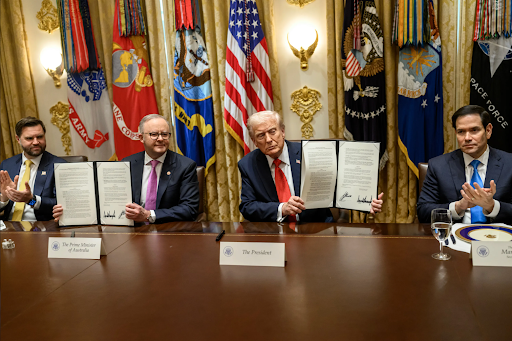
Prime Minister Anthony Albanese and President Donald Trump at the signing of the US-Australia Critical Minerals Agreement on October 20, 2025. From The White House.
By Willa Mack ‘29
On October 20, 2025, Australian Prime Minister Anthony Albanese and President Donald Trump finished five months of negotiations and signed the U.S.-Australia Critical Minerals Agreement. Under this “landmark bilateral framework,” each government will invest at least $1 billion in the next six months towards creating critical mineral projects. The deal allows the U.S. to access Australia’s mineral resources in exchange for Australian investment in American defense companies. The goal of this geopolitical partnership is twofold. First, both countries hope to create a secure rare earth mineral supply chain. Second, they hope to weaken China’s grip on the global rare earth minerals trade through “economic policy tools and coordinated investment” such as price floors and exclusive trade agreements.
Rare earth minerals, such as neodymium, praseodymium, and scandium, are necessary in today’s defense industries, technologies, renewable energy structures, and electric vehicles. From helping your personal laptop work to ensuring fighter jets and defense radar systems can function, rare earth minerals play a critical role in ensuring our world functions smoothly and thus have emerged as one of the most powerful bargaining chips in diplomatic negotiations.
Details of the Deal
The countries’ investments are primarily split between two priority projects in Australia. The first is the Alcoa-Sojitz Gallium Recovery Project in Western Australia. Once completed, this project is expected to generate 10% of the entire global gallium supply; gallium is needed for semiconductor manufacturing and transmitting data along fiber optic lines. The U.S. is investing $200 million in concessional equity finance into the project. So far, Japan has provided 50% of the project costs.
The second project is the Arafura Nolans Project in Australia’s Northern Territory, into which Australia is investing $100 million in equity. Once completed, Arafura Noals will provide 5% of global rare earth minerals, the majority of which will be used for energy security and defence initiatives.
In the days after the deal, the U.S. Secretary of Energy Chris Wright and Australian Minister for Resources Madeleine King jointly established the U.S.-Australia Critical Minerals Supply Security Response Group. Once the priority projects are up and running, this group will identify priority minerals and supply vulnerabilities in the global market that Australia and the U.S. can work to fill. It will also administer post-project analysis of Alcoa-Sojitz and Arafura Nolans according to each country’s domestic laws. In the meantime, the group is developing a plan to accelerate the processing of rare earth minerals and working out how to best leverage existing policy—such as American stockpiling infrastructure or the Australian Critical Mineral Strategic Reserve—to further their respective industrial bases.
Once these projects become viable sources for rare earth markets, Trump and Albanese are going to turn towards price mechanisms and protect their supply from non-market policies. To combat China’s rare earth dominance, the U.S. and Australia will adopt a standards-based system wherein those who agree to the standards can trade freely within the determined pricing framework.
The Costs of Doing Business
However, the $1 billion investment from either side isn’t the only money going into maintaining the countries’ relationship. On the American side, the Department of War (DoW) will invest an undisclosed amount in the construction of an advanced gallium refinery in Western Australia, expected to produce 100 metric tons per year once completed.
As for Australia, Albanese’s government is going to purchase $1.2 billion worth of Anduril autonomous underwater vehicles in a move to step up their deep-sea defense. Anduril Industries is a major private defense technology vendor for the U.S. government; in January this year, the DoW awarded the company $14.3 million in contracts. Since February, Australia has contributed $1 billion to modernizing the U.S. submarine industrial base and is now expected to contribute another billion by the end of 2026. Both of these financial commitments focused on ocean defense are in part to encourage Trump to continue America’s commitment to AUKUS, a trilateral partnership between Australia, the US, and the United Kingdom aimed at promoting a free and open Indo-Pacific. AUKUS has been in place since 2021, and since this rare earth minerals deal, Trump has appeared to have recommitted to the partnership.
Australia has also pledged to spend $2.6 billion on the first tranche of Apache helicopters. Finally, through Australia’s Guided Weapons and Explosive Ordnance enterprise, the U.S. is securing munitions supply-chain resilience that Trump claims will directly support 200+ manufacturers in Texas, Florida, Arkansas, and Alabama.
Why Australia? Fixing a Fraught Friendship
Australia is “home to much of the periodic table,” including over 5% of global rare earth mineral reserves. However, the country has been slow to begin effectively extracting and processing these elements due to the technological capacity and high investment it requires, the environmental degradation it causes, and the low yield it results in. These metals—including cobalt, lithium, neodymium, praseodymium, manganese, tungsten, gallium, and more—are essential, but typically only in small quantities. Thus, private companies are less likely to invest in them due to the expectedly low profit margins.
Despite the private sector’s hesitation to engage specifically with rare earth minerals, Australia has one of the strongest mining sectors in the world and has 89 active rare earth exploration projects (compared to Canada’s 18 and Brazil’s 13). Since declaring the critical minerals sector a “priority industry” and aligning its goals with Australian technological priorities, Australia has made slow but steady progress towards expanding its rare earth mining capacity. The Australian Department of Industry, Science and Resources writes: “We are growing our critical minerals sector to make Australia a world-leading producer of raw and processed critical minerals.” In 2024, Australia was the top destination for rare earth exploration, receiving 45% ($64 million) of worldwide investment in critical minerals mining, more than five times the amount invested in Brazil, the next largest recipient. The Australian Stock Exchange also recently became the second-largest source of financing for junior and mid-tier mining companies.
According to the Center for Strategic and International Studies, “Australia holds three decisive advantages—world-class geological reserves, strong capital markets, and deep human capital.” Through this deal, both countries hope to unleash Australia’s rare earth potential and become a “model for supply-chain cooperation globally.”
But this deal is not only a model for global markets. It is a model for how the U.S. can repair relationships that Trump has disrupted since retaking office in January. Tensions recently rose between the U.S. and Australia when Trump levied excessive tariffs against the country, like he has to other American allies. Thus, this deal comes at a critical point in the countries’ 70+ years of formal alliance. And from the Australian side, Albanese was working hard to remind Trump of the value of an alliance with Australia. Analysis from The New York Times explained that by “floating its potential to help the US on the minerals, Australia could press on other points of contention between the countries,” such as the renewal of the U.S.’s commitment to AUKUS or the removal of the 50% tariff on steel and aluminum exports.
In public, both leaders have lauded their countries’ close relationship since signing the deal. Albanese stated that “there are no closer friends and allies than the United States of America and Australia,” and that this “cooperation” on rare earth minerals is “testament to [that] trusted partnership.” However, on paper, it is clear that not all the damage has been undone; the legalistic aspects of this new partnership reflect the expected possibility of future disagreement between Trump’s far-right and Albanese’s center-left administrations.
According to Albanese, this agreement is not “legally binding [or] enforceable,” a distinction which means either country could back out of the deal with little legal consequence. The political consequences, however, could be extreme, and might extend China’s lead in the race for global rare earth supply chain dominance.
China
As of this year, China controls 70% of mining, 92% of processing, and 98% of magnet manufacturing of rare earth minerals. Given the escalating tensions between China and both the U.S. and Australia, Chinese control of the market leaves these Western powers rather vulnerable to the Chinese government. Despite this supply chain insecurity, global mineral market expert Matt Warder explains that “Western efforts to counter China’s dominance have been fragmented and reactive,” making this bilateral deal unique in the fight to create a Western-controlled market.
This fight, however, poses an outsized economic risk for Australia. The country’s economy, particularly its mining industry and economy, is deeply connected to China’s; China buys 33% of Australia’s overall exports and over 75% of Australia’s iron ore exports from mining. Before the deal was finalized and announced in October, the Chinese state media issued a warning to Australia that it would not tolerate “infringements on its core interests,” suggesting that any Australian deal that would threaten Chinese dominance of rare earth markets (as this deal explicitly does) would yield consequences.
However, it was China’s actions in early October that truly opened the door for this deal to pass. On October 9, the Chinese government tightened its grasp on the rare earth minerals global supply chain, causing “havoc in global stock markets.” This move falls into a larger pattern wherein China has manipulated the global rare earth minerals markets, often by flooding it with excess supply to make prices low. These artificially low prices limit competition in the market and encourage countries to continue buying from China for cheap, furthering their global energy dominance. However, their October 9 attempt, rather than benefiting them, opened the door for Australia to legislate with the US.
Now, the new Australian-American agreement will create standards-based trading systems within an alternate rare earth minerals market that is legal and more fiscally accessible to other governments. Finally, Australia and the U.S. pledged to curb China’s acquisition of new mining assets through existing tools, such as domestic investment screening and diplomatic efforts, to limit Chinese expansion into third-country markets.
Although these results will take some time to come to fruition—obtaining mine permits, building mines, and rerouting global markets are time consuming processes—Trump has claimed that we will see substantive results within one year: “We’ll have so much critical minerals and rare earths that you won’t know what to do with them.” The only results we have seen so far, however, are limited to stock values. After the announcement, the shares in Australian mining companies increased: Arafura Rare Earths and Iluka Resources, both headquartered in Perth, jumped by 7.7% and 3%, respectively.
Global supply chains expert Matt Warder writes that “if China represents the center of gravity in the rare-earth universe, Australia is increasingly shaping up as its Western counterweight.” This deal is Australia’s test: will the nation successfully tip the scales towards Western rare earth dominance?