A Law-Based Reminder: U.S. President Donald J. Trump Lacks Authority to Pardon Crimes Against International Law
Louis René Beres (Ph.D., Princeton, 1971)
Professor Emeritus of International Law
Purdue University
Abstract: Since the start of his second term in January 2025, US President Donald J. Trump has granted pardons of criminal convictions and sentence-shortening commutations to more than 1,700 people. In cases where pertinent crimes expressed offenses against international law (aka the “Law of Nations”), no such pardon could be considered valid under United States law. On several levels, this president’s open abuse of the pardoning power has inflicted a continuous assault on America’s constitutional foundations.[1] Though generally overlooked or ignored, some of these core derelictions have been violations of codified Nuremberg obligations[2] and the “Higher Law” precepts from which these obligations derive.
“A government of laws, and not of men.”
John Adams, 1774
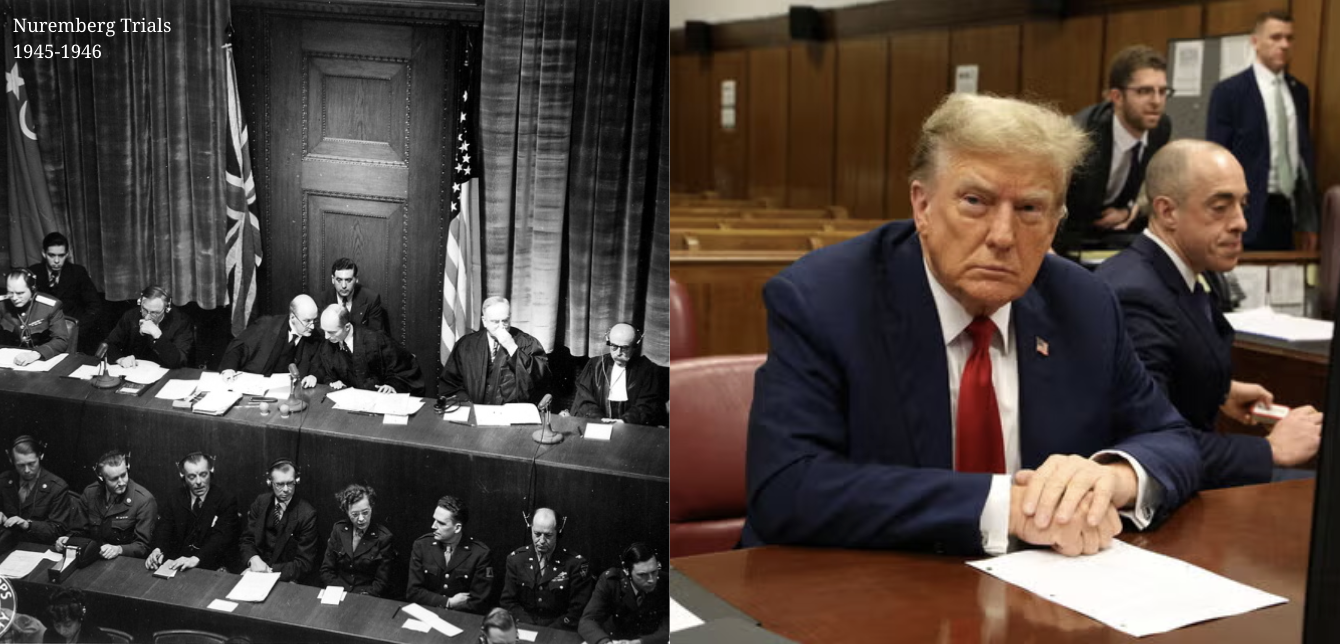
The declared purpose of the International Military Tribunal at Nuremberg (1945-46) was to punish crimes against international law. Though some of the individuals convicted for war crimes were subsequently granted commutations of sentence for extra-legal (i.e., geopolitical) reasons,[3] an overriding general principle[4] continued to affirm that there should be no such crimes without proper punishments (“Nullum crimen sine poena”).[5] In its origins, this “no pardon” principle stems from an always-binding “Higher Law,” the universal and immutable doctrine on which the United States Constitution was based.
But what does America’s foundational document say about US presidential obligations that concern crimes against international law? To begin, we may look back at Donald Trump’s first-term pardons for persons convicted of such crimes.[6] While the individuals involved didn’t rise to the levels of wrongdoing associated with the prematurely-released Nazi war criminals, Donald Trump’s grants of presidential pardon and commutation[7] left an ineradicable stain on United States criminal justice.[8] Looking ahead, the derivative and guiding question should be: Is the United States really “a government of laws, not of men,” and will Trump’s second term produce similar or worse legal defilements?
Now, in September 2026, a more detailed history deserves pride of place. The Constitution stipulates that no US president can claim legal authority (whether codified or customary) to pardon crimes against international law.[9] Related to this unambiguous prohibition is the corollary obligation to oppose foreign leaders who violate humanitarian international law (the law of war) or the broader norms of general international law. Currently, the most conspicuously egregious violation is Donald Trump’s persistent refusal to meaningfully condemn Vladimir Putin’s force-multiplying offenses against Ukraine. These Nuremberg-level offenses include crimes of war, crimes against peace and crimes against humanity.
While Donald Trump’s first-term pardoning actions for Nuremberg-level crimes were inadmissible under US law,[10] and although the former and now incumbent president was subsequently indicted for major crimes in multiple judicial jurisdictions, he was allowed to “succeed” with this unhidden dereliction.[11] Though typically unfamiliar even to capable jurists and conscientious legal scholars, variously relevant issues of international law ought to have been raised more forcefully by the citizenry and its representatives[12] in “a government of laws, not of men.” Jurisprudentially and philosophically, international law[13] shares its Natural Law[14] (aka Higher Law) origins with US law. Among other things, all three normative systems are inextricably intertwined and mutually reinforcing.
In this matter, the key legal problem is plain and straightforward. The Law of Nations is part of the law of the United States.[15] Notwithstanding certain evident and substantial intersections of US law, Natural Law[16] and international law,[17] the United States Constitution is abundantly clear on one specific separation: A US president's power to pardon does not extend to violations of international law.
This power is limited to "Offenses against the United States." Moreover, these offenses are never subject to idiosyncratic, whimsical or loosely ad hoc definitions. Explicitly, they are confined to "...only those offenses declared to be such by the solemn action of the legislative body."[18]
There are assorted correlative details. International law is federal common law. The constitutionality of federal subject matter jurisdiction on such matters is established at Articles III and VI of the Constitution and in various actions involving US treaty violations. Per Judge Edwards in Tel-Oren, actions involving violations of international law arise under US law because the Law of Nations[19] is “an integral part of the laws of this country."[20]
What are evident facts of Trump I-pardoning cases?[21] Did any of Donald J. Trump's late 2020 pardons concern identifiable violations of international law?[22] If "yes," these openly-flaunted grants of presidential “largesse” were unlawful on their face.
Only a few flagrant examples of illegally-granted pardons[23] during Trump’s first term were acknowledged in official DOJ (Department of Justice) records.[24] Additional evidence may still surface during Trump II, but it would likely be ignored. At that stage, Trump I pardoning crimes may have become legally moot and avoidance of similar crimes during Trump II will become utterly unimportant.
Could the president’s first term pardoning actions have been justified by clever word play regarding legal definitions? For example, in those key cases that involved crimes of war,[25] a competent legal scholar might have argued more or less persuasively that the Trump pardons were not issued solely or even primarily for specific violations of international law. In part, at least, such an argument could have been based on well-established understandings that the laws of war - aka humanitarian international law - have long been "incorporated" into the laws of the United States[26] and that presidential pardons rightfully concerned these US legal norms.
Still, “not so fast” should be the informed response to such an argument. Any such highly “selective” assessment would have to overlook that Trump I pardons (1) represented an obvious abuse of a US president's Constitutional obligation to "faithfully execute the law"[27] and (2) ignored the always-complementary expectation that a pardon must represent "an act of grace, one proceeding directly from the power entrusted with the execution of the laws...."[28]
Looking back, variously impermissible Trump I pardons were not unfathomable or indecipherable.[29] Jurisprudentially, the president’s generally-specious first-term pardons were anything but "an act of grace." Instead, when understood in refined legal-philosophical terms, they expressed cynical re-affirmations of the Sophist view of justice most famously revealed by Plato. Declares Thrasymachus in The Republic: "Right is the interest of the stronger."[30] Could anyone reasonably doubt that this classical affirmation of Realpolitik remains the core ideology of “Trump II?”
The complex legal problems earlier considered by the January 6 investigative committee ought to have included presidential abuses of the US Constitution's pardoning power. In principle, at least, the Committee’s mandate should have considered how best to ensure that invalid exonerations for crimes against international law are never repeated by any American president. Ironically, in this particular matter, the successor American president is Donald J. Trump.
Credo quia absurdum, said Roman philosopher Tertullian: “I believe because it is absurd.”
Still, there are remedies. At some point, a prospective plaintiff with appropriate judicial “standing” in foreseeable pardoning matters could bring legitimate claims into a US federal court by means of the Alien Tort Statute (1789).[31] Examples might be foreign nationals and/or identifiable relatives of victims injured or killed by one or several American beneficiaries of a Trump presidential pardon. Nonetheless, even if civil law remedies were allowed in such a claim, this judicial strategy would not plausibly revoke or remediate unconstitutional Trump I pardons.
Today, after examining well-documented Trump derogations, legal scholars and public officials could not reasonably doubt the president’s pardon-associated violations of international law.[32] One de facto result of Donald J. Trump's illegal pardoning of individual US citizen actions has been retroactive eliminations of criminal responsibility. During Trump I, the president's pertinent pardons were illegal on two separate but interrelated grounds:(1) the general invalidity of pardons for violations of the law of nations and (2) the specific exoneration of international crimes.
What has been learned? What should be done to prevent similar presidential wrongdoing during the remainder of Trump’s second term? Also, how could this urgent legal imperative support world legal order?
Under authoritative international law,[33] criminal responsibility of individuals can never be removed by the unilateral actions of a national government.[34] A “person” is always liable for punishment by international law independently of any provisions of internal law. This fundamental principle references the unchallengeable "supremacy" of international law over national law.[35] At Nuremberg, the Tribunal included the following key statement in its final judgment: "...the very essence of the Charter (London Charter of August 8, 1945) is that individuals have international duties which transcend the national obligations of obedience imposed by an individual state."[36] Plainly, by their actions and comments during Trump II, neither the president nor his “Secretary of War” is willing to uphold binding Nuremberg Principles. In the matter of Senator Kelly and certain others, both Trump and Hegseth have taken the indefensible position that chain of command obedience takes precedence over Nuremberg obligations to disobey unlawful orders. Again, the president and his “team” should be reminded that these obligations are fully incorporated in America’s Uniform Code of Military Justice.
There is more. All states have an obligation[37] to avoid "denials of justice"[38] in the sense of international law. This peremptory obligation is based on reasonable concerns that by pardoning a criminal, a particular state "assumes responsibility for his past acts."[39] In specific regard to impermissible Trump pardons, both past and prospective (especially ones involving tangible war crimes), this means reputational consequences that include substantial legal diminutions of the United States as such.[40]
It would always be better to demand presidential reversal at the actual time of wrongful pardons. Regarding Trump’s first term pardons for crimes against the law of nations, once these grants had become a fait accompli, efforts at remediation became exceedingly difficult. Looking ahead, any United States Congress and/or Supreme Court should finally understand that no nation-state or its leaders can ever exculpate or exonerate violations of international law. Among other sources, the principles of national legal responsibility clarified and codified at Nuremberg are not in any manner volitional obligations. Ultimately, after all, it is for verifiably sound reasons of human interdependence[41] and human “oneness”[42] that the US Constitution incorporates and codifies “Higher Law.”
Recalling Sophocles’ Antigone (442 BCE), any sovereign’s legal responsibility (whether king or president) must be to his/her own country and to the wider world. Whenever an American president issues pardons to violators of the Law of Nations, he undermines certain core legal precepts of human interdependence (“co-responsibility”). Ranging from Justinian, Grotius and Vattel to present-day United States law, these precepts figure importantly in the Constitution and are central to explaining any president’s unequivocal incapacity to pardon crimes against international law.
During his first term, “beyond any reasonable doubt,” President Donald J. Trump’s willingness to issue such pardons undermined US Higher Law Nuremberg obligations to global security and justice. Now, well into his second term, Trump is apt to consider new pardons and commutations for selected US military personnel who have been sentenced for violations of the Law of War. Here, though the president’s lawyers would defend such presidential “relief” on grounds that they were dealing with issues US military law (i.e., Uniform Code of Military Justice), they would be proceeding on manipulated or contrived legal ground. This is because the president’s clemency actions would most fundamentally concern original violations of the Law of Nations.
For capable scholars and policy-makers, conclusions should be “self-evident.” In certain still-conceivable scenarios, choosing once again to ignore the US Constitution-based rule on pardons for international crimes could encourage catastrophic war and/or genocide–like crimes. Such intolerable outcomes could include a nuclear war.[43]
There is still more. Domestic politics should never be allowed to displace a national leader’s obligation to aid and enforce the Law of Nations.[44] Still, in late 2026, a second-term US president is openly magnifying his previous derelictions of national and international law. Among many other things, such American presidential defilements point toward steadily-expanding violations of the principal jus cogens Nuremberg obligation: “No crime without a punishment.”
At this stage, Trump’s most worrisome stance on crimes against international law concerns future pardons for sentenced war criminals and de facto support for Russian crimes against Ukraine. As these Putin-inflicted crimes include crimes of war, crimes against peace and crimes against humanity, any US presidential indifference to law-based obligations would remain inexcusable and irremediable. In view of Trump-dictated postures for the Department of Defense (significantly re-named the “Department of War”), the most plausible prospect of unlawful pardons would concern international humanitarian law. Ipso facto, by ignoring his Constitutional obligations to support the law of armed conflict, President Trump would be acting contrary to John Adam’s 1774 plans for “a government of laws, and not of men.”[45]
Any such act would be unpardonable.
[1] These foundations include the ineradicable expectations of a “Higher Law.” On this peremptory law, see Edward S. Corwin, The “Higher-Law” Background of American Constitutional Law (Cornell University Press, 1928.). Here, Corwin wrote famously of the American Constitution as an expression of the Higher Law, that is “…in fact imperfect man’s most perfect rendering of what Blackstone saluted as `the eternal, immutable laws of good and evil, to which the creator himself in all his dispensations conforms’” (p. vi).
[2] See PRINCIPLES OF INTERNATIONAL LAW RECOGNIZED IN THE CHARTER AND JUDGMENT OF THE NUREMBERG TRIBUNAL. Report of the International Law Commission, 2nd session, 1950, U.N. G.A.O.R. 5th session, Supp. No. 12, A/1316, p. 11
[3] For geopolitical reasons (i.e., Cold War with the Soviet Union), American occupation officials set many convicted Nazi war criminals free ahead of schedule. See: https://www.nationalww2museum.org/war/articles/american-justice-at-nuremberg-military-tribunals
[4] Subsequently identified at art. 38 of the UN’s Statute of the International Court of Justice as “the general principles of law recognized by civilized nations.”
[5] “So far from it being unjust to punish him, it would be unjust if his wrongs were allowed to go unpunished.” (Nuremberg Tribunal, 1946).
[6] From America’s Constitutional beginnings, the laws of war have been “incorporated” into the laws of the United States. It was on the basis of these specific incorporations, not original international law prohibitions, that four “Blackwater defendants” (Nicholas Abram Slatten; Paul Alvin Slough; Evan Shawn Liberty and Dustin Laurent Heard) were prosecuted by the US Department of Justice. It follows that the herein-discussed international law exception to a US president's power to pardon could not have been correctly invoked in these cases. The language of the respective pardons excused the defendants only for crimes committed under US law, which would have included Title 18 federal court) and Title 10 (military court). Nonetheless, at least in principle, these four convicted and subsequently pardoned war criminals could still have become the object of assorted extradition requests regarding alleged war crimes in Iraq and/or Afghanistan (venues outside of the United States). In principle, at least, all four Blackwater defendants remain subject to arrest and prosecution if they should travel anywhere outside the United States. The date of the relevant crimes at Nisur Square in Baghdad, Iraq was September 16, 2007. The jury verdict in the US District Court for the District of Columbia was announced on October 22, 2014.
[7] In 2019, President Donald Trump pardoned four members of the US military (Major Golsteyn, Chief Gallagher, Lieutenant Behenna and Lieutenant Lorance) after they were accused of or convicted of egregious violations of international criminal law (thus violations ipso facto of US military law). Inter alia, the following argument will clarify that these pardons were not a valid exercise of the President’s constitutional authority and were simultaneously in violation of international criminal law and US law. Though not examined herein, an augmenting position could reasonably claim that the President of the United States himself had committed a war crime by granting these constitutionally invalid pardons. In this connection, the relevant legal concept centers on variously binding issues of command responsibility. See: Ford, Stuart (2020) "Has President Trump Committed a War Crime by Pardoning War Criminals, “American University International Law Review: Vol. 35: Iss. 4, Article 3.
Available at: https://digitalcommons.wcl.american.edu/auilr/vol35/iss4/3
[8] Wrongful Trump pardons for crimes against international law would not be “obiter dicta” or incidental to broader abuses of the presidential pardoning power. They would be of consequence in themselves or significant per se. Derived from the English common law, obiter dicta mean “that which is said in passing.” It references a passage of judicial opinion which is not necessary for the decision of any actual case before the court. Though obiter dicta lack the force of precedent, they may nonetheless be judicially significant.
[9] This presidential pardoning exclusion derives from every state’s broad and irrevocable obligations under international law. To wit: "States shall not take...any measures which may be prejudicial to the international obligations they have assumed in regard to the detection, arrest, extradition and punishment of persons guilty of war crimes and crimes against humanity." See: Principles of International Cooperation, General Assembly Resolution, 1973[9] See Principles of International Cooperation in the Detection, Arrest, Extradition and Punishment of Persons Guilty of War Crimes and Crimes Against Humanity, GA Res. 3074 (XXVlll), 3 December 1973.
[10] See e.g., United States v La Jeune Eugenie, 26 F. Case. 832, 846 (C.C.D. Mass, 1822) (No. 15, 551) (regarding "an offense against the universal law of society.) Per Jordan J. Paust, "...violations of international law are not merely offenses against a sovereign, and a sovereign cannot absolve them." See: Jordan J. Paust, "Contra gate and the Invalidity of Pardons for Violations of International Law," Houston Journal of International Law, Vol. 10:51 (52). It should also be noted that Professor Paust's refined work on these complex legal issues was both seminal and exemplary.
[11] See, by this author, at Yale Global, Louis René Beres, https://yaleglobal.yale.edu/content/after-mueller-report; see also, by Professor Beres at JURIST: https://www.jurist.org/commentary/2020/12/louis-rene-beres-presidential-crimes-and-pardons/; and Louis René Beres, https://www.jurist.org/commentary/2020/08/louis-beres-trump-punishment/
[12] For the authoritative sources of international law, see art. 38 of the Statute of the International Court of Justice: STATUTE OF THE INTERNATIONAL COURT OF JUSTICE, Done at San Francisco, June 26, 1945. Entered into force, Oct. 24, 1945; for the United States, Oct. 24, 1945. 59 Stat. 1031, T.S. No. 993, 3 Bevans 1153, 1976 Y.B.U.N., 1052.
[13] The US Neutrality Act, 18 U.S.C. Sec. 960 (originally Sec. 25) (1794) was enacted in order to implement this Law of Nations. Pertinent Congressional authority derived most specifically from article 1, Section 8, clause 10 of the U.S. Constitution. See also Talbot v. Jansen, 3 U.S. (3 Dall.) 133, 156 (1795) (Paterson, J).
[14] Natural law is based upon the acceptance of certain principles of right and justice that prevail because of their own intrinsic merit. Eternal and immutable, they are external to all acts of human will and interpenetrate all human reason. This dynamic idea and its attendant tradition of human civility runs continuously from Mosaic Law and the ancient Greeks and Romans to the present day. For a comprehensive and far-reaching assessment of the natural law origins of international law, see Louis René Beres, "Justice and Realpolitik: International Law and the Prevention of Genocide," The American Journal of Jurisprudence, Vol. 33, 1988, pp. 123-159. This article was adapted from Professor Beres' earlier presentation at the International Conference on the Holocaust and Genocide, Tel-Aviv, Israel, June 1982.
[15] International law is part of US domestic law. In the precise words used by the U.S. Supreme Court in The Paquete Habana, "International law is part of our law, and must be ascertained by the courts of justice of appropriate jurisdiction, as often as questions of right depending upon it are duly presented for their determination. For this purpose, where there is no treaty, and no controlling executive or legislative act or judicial decision, resort must be had to the customs and usages of civilized nations." See The Paquete Habana, 175 U.S. 677, 678-79 (1900). See also: The Lola, 175 U.S. 677 (1900); Tel-Oren v. Libyan Arab Republic, 726 F. 2d 774, 781, 788 (D.C. Cir. 1984) (per curiam) (Edwards, J. concurring) (dismissing the action, but making several references to domestic jurisdiction over extraterritorial offenses), cert. denied, 470 U.S. 1003 (1985) ("concept of extraordinary judicial jurisdiction over acts in violation of significant international standards...embodied in the principle of `universal violations of international law.'").
[16] Emmerich de Vattel’s Law of Nations or the Principles of Natural Law (1758) gives important emphasis to the natural law origins of international law. Arguing from the assumption that nations are no less subject to the laws of nature than are individuals, he concludes that what one man owes to other men, one nation, in turn, owes to all other nations: “Since Nations are bound mutually to promote the society of the human race, they owe one another all the duties which the safety and welfare of that society require.” With this in mind, Vattel proceeded to advance a permanent standard by which we can distinguish between lawful and unlawful practices in global affairs: “Since, therefore, the necessary Law of Nations consists in applying the natural law to States, and since the natural law is not subject to change, being founded on the nature of things and particularly upon the nature of man, it follows that the necessary Law of Nations is not subject to change. Since this law is not subject to change, and the obligations which it imposes are necessary and indispensable, Nations can not alter it by agreement, nor individually or mutually release themselves from it." (See: Vattel, The Law of Nations, supra, Introduction to Book I, p. 4.)
[17] See William Blackstone’s Commentaries on the Law of England (Book 4): “Each state is expected, perpetually, to aid and enforce the law of nations, as part of the common law, by inflicting an adequate punishment upon the offenses against that universal law.”
[18] See United States v. Grossman, 1 F. 2d 941, 950 (N.D. 111. 1924).
[19] This law includes certain norms of a customary as well as codified nature. Article 38(1)(b) of the Statute of the International Court of Justice describes international custom as "evidence of a general practice accepted as law." 59 Stat. 1031, T.S. No. 993 (June 26, 1945). The norms of customary international law bind all states irrespective of whether a State has ratified the pertinent codifying instrument or convention. International law compartmentalizes apparently identical rights and obligations arising both out of customary law and treaty law. "Even if two norms belonging to two sources of international law appear identical in content, and even if the states in question are bound by these rules both on the level of treaty-law and on that of customary international law, these norms retain a separate existence." See Military and Paramilitary Activities (Nicaragua v. U.S.), 1986 I.C.J. Rep. 14, para. 178 (June 27).
[20] 726 F.2d at 787 (Edwards, J., concurring).
[21] In July 2026, The New York Times reported that Trump had "quietly denied nearly 6,000 clemency applications" from "people who mostly lacked political connections and had waited in queue while he awarded pardons and commutations to allies who had skipped the line.” Though more than half of Trump pardons have gone to wealthy white collar criminals (i.e., money laundering and fraud cases), others were sentenced for all manner of violent crime.
[22] In this regard, consider again Emmerich de Vattel, The Law of Nations (1758), "The first general law, which is to be found in the very end of the society of Nations, is that each Nation should contribute as far as it can to the happiness and advancement of other Nations." Various behaviors thought to be justly pardonable by an American president could nonetheless undermine Vattel’s “general law.”
[23] Illegally granted because they pertain to assorted violations of international law.
[24] See, US Department of Justice: https://www.justice.gov/pardon/pardons-granted-president-donald-trump
[25] "Crimes of War" concern (1) laws on weapons; (2) laws on warfare; and (3) humanitarian rules. Codified primarily at The Hague and Geneva Conventions, and known thereby as the Law of The Hague and the Law of Geneva, these rules seek, inter alia, to bring discrimination (distinction); proportionality and military necessity into belligerent calculations. On the main corpus of jus in bello, see: Convention No. IV, Respecting the Laws and Customs of War on Land, With Annex of Regulations, Oct. 18, 1907, 36 Stat. 2277, T.S. No. 539, 1 Bevans 631 (known commonly as the "Hague Regulations"); Convention for the melioration of the Condition of the Wounded and Sick in Armed Forces in the Field, Aug. 12, 1949, 6 U.S.T. 3114, T.I.A.S. No. 3362, 75 U.N.T.S. 85; Convention Relative to the Treatment of Prisoners of War, Aug. 12, 1949, 6 U.S.T. 3316, T.I.A.S. No. 3364, 75 U.N.T.S. 135; Convention Relative to the Protection of Civilian Persons in Time of War, Aug. 12, 1949, 6 U.S.T. 3516, T.I.A.S. No. 3365, 75 U.N.T.S. 287.
[26] It was on the basis of these incorporations (and not antecedent codified and/or customary international law) that the four Blackwater defendants were originally prosecuted by the US Department of Justice. It follows that the herein-discussed international law violation exception to a US president's power to pardon might not be correctly invoked in these specific cases. The actual language of their respective pardons excused them only for crimes under US law, which would have included Title 18 federal court) and Title 10 (military court). Nonetheless, at least in principle, these four convicted and pardoned war criminals could still become the object of correctly prepared extradition requests for alleged war crimes in Iraq and/or Afghanistan (venues outside the United States).
[27] Criminal responsibility of leaders under international law is not limited to direct personal action or by official position. On the principle of command responsibility, or respondeat superior, see, e.g., Yamashita v. Styer, 327 U.S. 1(1945); Trial of Wilhelm von Leeb (Case No. 72) 12 L. Rep. Trials War Criminals 1 (1948); William V. O’Brian, The Law of War, Command Responsibility and Vietnam, 60 GEO. L.J.605 (1972); William H. Parks, Command Responsibility for War Crimes, 62 MIL. L. REV. 1(1973). The direct individual responsibility of leaders is also unambiguous in view of the London Agreement, which denies defendants the protection of the act of state defense. See Agreement for the Prosecution and Punishment of the Major War Criminals of the European Axis art. 7, Aug. 8, 1945, 59 Stat. 1544, 82 U.N.T.S. 279.
[28] See United States v, Wilson, 32 (U.S. 7 Pet., 150, 160 (1833) (Marshall, CJ writing for the majority.). See also, Laurence Tribe, American Constitutional Law 193, n.10 (1978). On the president's obligation to faithfully execute international law, see: J. Paust, "The President is Bound by International Law," 81 A. J. Int'l L., 377(1987).
[29] Said US Federal Judge Robert Pain: “It’s not surprising that a criminal like Trump pardons other criminals, but apparently to get a pardon, one has to be either a Republican, a convicted child murderer or a turkey.” (Judge Pain, Southern District of Iowa, 28 December 2020.)
[30] Bk. I, Sec. 338 of Plato, The Republic, (B. Jowett tr., 1875). But contrast with Plato’s own view in The Republic: “Justice is a contract neither to do nor to suffer wrong.” See also, Philus in Bk III, Sec. 5 of Cicero, DE REPUBLICA.
[31] Originally enacted as section 9 of the Judiciary Act of 1789, granting to district courts original jurisdiction over "any civil action by an alien for a tort only, committed in violation of the law of nations or a treaty of the United States." In 1980, in a suit pertaining to the international crime of torture (a crime conceivably relevant to one or more of the listed Trump pardon beneficiaries), the US court upheld federal jurisdiction under the Alien Tort Statute because the crime of torture was in violation of "modern international law." See: Filarial v. Pena-Irala; 630 F.2d, 876 (2d Cir. 1980) (Kaufman, J.).
[32] See for example, Respublica v. De Longchamps, 1 U.S. (1 Dall.) 111 (Pa. Sup. Ct 1784).
[33] Today, key expectations of this always-overriding law lie in the twin–principles of sovereignty and self-determination. See, by this author: Louis Rene Beres, “Self-Determination, International Law and Survival on Planet Earth,” Arizona Journal of International and Comparative Law, Vol. 11., No. 1., 1994, pp. 1-26. See also: Declaration on Principles of International Law Concerning Friendly Relations and Co-operation Among States in Accordance with the Charter of the United Nations (The Principle of Equal Rights and Self-Determination of Peoples), G.A. Res. 2625, U.N. GAOR, 25th Sess., Supp. No. 28 at 121, U.N. Doc. A/8028 (1970), reprinted in 9 I.L.M. 1292; Declaration on the Granting of Independence to Colonial Countries and Peoples, G.A. Res. 1514, U.N. GAOR, 15th Sess., Supp. No. 16, at 66, U.N. Doc. A/4684 (1960); Principles Which Should Guide Members in Determining Whether or Not an Obligation Exists to Transmit the Information Called for Under Article 73e of the Charter, G.A. Res. 1541, U.N. GAOR, 15th Sess., Supp. No. 16, at 29, U.N. Doc. A/4684 (1960).
[34] A derivative issue here may concern the presence or absence of a formal “state of war.” Under both codified and customary international law, the question of whether or not a formal belligerency exists between states could be starkly ambiguous. Traditionally, it was held that an actual declaration of war was necessary before any "real” war could be presumed. Hugo Grotius divided all wars into declared wars, which were legal, and undeclared wars, which were not. (See Grotius, THE LAW OF WAR AND PEACE, Bk. III, Ch. iii, V and XI). By the beginning of the twentieth century, the position that war obtains only after a conclusive declaration of war by one of the parties, was codified by Hague Convention III. More precisely, this convention stipulated that hostilities must not commence without "previous and explicit warning" in the form of a declaration of war or an ultimatum. (See Hague Convention III Relative to the Opening of Hostilities, 1907, 3 NRGT, 3 series, 437, article 1.) Currently, of course, declaration of war may be tantamount to declarations of international criminality (because of the criminalization of aggression by authoritative international law), and it could be a jurisprudential absurdity to tie a state of war to formal declarations of belligerency. It follows that a state of war may exist without formal declarations, but only if there is an armed conflict between two or more states and/or at least one of these states considers itself at war. On the argument that war need not be formally recognized, see J. Pictet, IV Commentary, Geneva Convention Relative to the Protection of Civilian Persons in Time of War 20-1 (1958) ("no need for formal declaration of war, or for recognition of the existence of a state of war"); U.S. Dept. of Army FM 27-10, The Law of Land Warfare 7-8, paras. 8-9 (1956) (instances of armed conflict without declaration of war; law of war applies); The Prize Cases, 67 U.S. (2 Black) at 668 ("war may exist without a declaration on either side"); see also M. McDougal & F. Feliciano, LAW AND MINIMUM WORLD PUBLIC ORDER (1961), pp. 97-113 (legal status of war may be brought about by use of armed force). In early September 2026, both President Trump and Vice-President Vance argued that the conflict with Iran was “not really a war.” Under both national and international law, however, this is not a visceral or seat-of-the-pants determination. Rather, it is contingent on prior definition.
[35] For the matter here at hand, this post-Nuremberg supremacy extends to national leaders who are now legally responsible even for indirect crimes. Under an always-overriding international law, the criminal responsibility of leaders is not limited to direct personal action nor is it limited by official position. On the peremptory principle of “command responsibility,” or respondeat superior, see: In re Yamashita, 327 U.S. 1 (1945); The High Command Case (The Trial of Wilhelm von Leeb), 12 LAW REPORTS OF TRIALS OF WAR CRIMINALS 1 (United Nations War Crimes Commission Comp., 1949); see Parks, COMMAND RESPONSIBILITY FOR WAR CRIMES, 62 MIL.L. REV. 1 (1973); O'Brien, THE LAW OF WAR, COMMAND RESPONSIBILITY AND VIETNAM, 60 GEO. L.J. 605 (1972); U S DEPT OF THE ARMY, ARMY SUBJECT SCHEDULE No. 27 - 1 (Geneva Conventions of 1949 and Hague Convention No. IV of 1907), 10 (1970). The direct individual responsibility of leaders is also unambiguous in view of the London Agreement, which denies defendants the protection of the act of state defense. See AGREEMENT FOR THE PROSECUTION AND PUNISHMENT OF THE MAJOR WAR CRIMINALS OF THE EUROPEAN AXIS, Aug. 8, 1945, 59 Stat. 1544, E.A.S. No. 472, 82 U.N.T.S. 279, art. 7.
[36] The principles of international law recognized by the Charter of the Nuremberg Tribunal and the judgment of the Tribunal were affirmed by the U.N. General Assembly as AFFIRMATION OF THE PRINCIPLES OF INTERNATIONAL LAW RECOGNIZED BY THE CHARTER OF THE NUREMBERG TRIBUNAL. Adopted by the U.N. General Assembly, Dec. 11, 1946. U.N.G.A. Res. 95 (I), U.N. Doc. A/236 (1946), at 1144. This AFFIRMATION OF THE PRINCIPLES OF INTERNATIONAL LAW RECOGNIZED BY THE CHARTER OF THE NUREMBERG TRIBUNAL (1946) was followed by General Assembly Resolution 177 (II), adopted November 21, 1947, directing the U.N. International Law Commission to "(a) Formulate the principles of international law recognized in the Charter of the Nuremberg Tribunal and in the judgment of the Tribunal, and (b) Prepare a draft code of offenses against the peace and security of mankind...." (See U.N. Doc. A/519, p. 112). The principles formulated are known as the PRINCIPLES OF INTERNATIONAL LAW RECOGNIZED IN THE CHARTER AND JUDGMENT OF THE NUREMBERG TRIBUNAL. Report of the International Law Commission, 2nd session, 1950, U.N. G.A.O.R. 5th session, Supp. No. 12, A/1316, p. 11.
[37] According to Article 53 of the Vienna Convention on the Law of Treaties: “…a peremptory norm of general international law is a norm accepted and recognized by the international community of states as a whole as a norm from which no derogation is permitted and which can be modified only by a subsequent norm of general international law having the same character.” See: Vienna Convention on the Law of Treaties, Done at Vienna, May 23, 1969. Entered into force, Jan. 27, 1980. U.N. Doc. A/CONF. 39/27 at 289 (1969), 1155 U.N.T.S. 331, reprinted in 8 I.L.M. 679 (1969).
[38] See The Federalist No. 80 (Alexander Hamilton).
[39] See 1 Restatement of the Foreign Relations Law of the United States (Revised) Sec. 711, 2B (Tent, Draft No, 6, 1985).
[40] Nullum crimen sine poena ("No crime without a punishment") is the key principle that distinguishes criminal law from civil law, and one that defines the overriding "competing expectation." Without prospect of punishment, there can be no distinction between a penal statute and any other statute. (See Redding v. State, 85 N.W. 2d 647, 652; Neb. 1957) (concluding that a criminal statute without a penalty clause is of no force and effect). The earliest statements of Nullum crimen sine poena can be found in the Code of Hammurabi (c. 1728-1686 B.C.); the Laws of Eshnunna (c. 2000 B.C.); the even-earlier Code of Ur-Nammu (c. 2100 B.C.) and the Lex Talionis or law of exact retaliation presented in three separate passages of the Jewish Torah or biblical Pentateuch. At Nuremberg, the words used by the Court, "So far from it being unjust to punish him, it would be unjust if his wrong were allowed to go unpunished,” represented an unambiguous reaffirmation of Nullum crimen sine poena. For the Court statement, see: A.P. d’ Entreves, Natural Law (London: Hutchinson University Library, 1964), p. 110.
[41] International law assumes a reciprocally general obligation of states to supply benefits to one another and to avoid war wherever possible. This core assumption of jurisprudential solidarity is a "peremptory" or jus cogens expectation. It can be found very early on in Justinian, Corpus Juris Civilis; Hugo Grotius, The Law of War and Peace (1625) and Emmerich de Vattel, The Law of Nations or Principles of Natural Law (1758).
[42] Concerning such "oneness," Americans may learn from Epictetus, the ancient Greek Stoic philosopher, "You are a citizen of the universe." An even broader idea of human interdependence followed the death of Alexander in 322 BCE, and with it came a coinciding doctrine of "universality.” By the Middle Ages, this political and social doctrine had fused with the notion of a Respublica Christiana, a worldwide commonwealth, and Thomas, John of Salisbury and Dante were looking upon Europe as a single and unified Christian community. Accordingly, below the level of God and his heavenly host, all humanity was to be considered as one. This is because all the world had allegedly been created for the same incontestable purpose; to provide a secular background for the always-overriding human drama of salvation. Here, but only in its relationship to the universe itself, was the world considered as part rather than a whole. More exactly, says Dante in De Monarchia: "The whole human race is a whole with reference to certain parts, and, with reference to another whole, it is a part. For it is a whole with reference to particular kingdoms and nations, as we have shown; and it is a part with reference to the whole universe, which is evident without argument."
[43] On the effects of a nuclear war, by this author, see: Louis René Beres, Apocalypse: Nuclear Catastrophe in World Politics (Chicago: University of Chicago Press, 1980); Louis René Beres, Mimicking Sisyphus: America's Countervailing Nuclear Strategy (Lexington, Mass., Lexington Books, 1983); Louis René Beres, Reason and Realpolitik: U.S. Foreign Policy and World Order (Lexington, Mass., Lexington Books, 1984); and Louis René Beres, Security or Armageddon: Israel's Nuclear Strategy (Lexington, Mass., Lexington Books, 1986). Most recently, by Professor Beres, see: Surviving Amid Chaos: Israel's Nuclear Strategy (New York, Rowman & Littlefield, 2016; 2nd ed. 2018). https://paw.princeton.edu/new-books/surviving-amid-chaos-israel%E2%80%99s-nuclear-strategy
[44] “States shall not take any measures which may be prejudicial to the international obligations they have assumed in regard to the detection, arrest, extradition and punishment of persons guilty of war crimes and crimes against humanity.” See: Principles of International Cooperation, General Assembly Resolution, 1973
[45] For original of this phrase, see John Adams, Novanglus Papers, No. 7 (1774). Adams likely drew this phrase from 17th century English political philosopher James Harrington. He later used it in the Declaration of Rights drafted specifically for the Massachusetts Constitution (1780).
LOUIS RENÉ BERES (Ph.D. Princeton 1971) is the author of many books and articles dealing with literature, art, philosophy, international relations and international law. Emeritus Professor of International Law at Purdue, he was born in Zürich at the end of World War II. Dr. Beres' twelfth book is Surviving Amid Chaos: Israel's Nuclear Strategy (Rowman & Littlefield, 2016) (2nd. ed., 2018) http://www.israeldefense.co.il/en/content/surviving-amid-chaos-israels-nuclear-strategy. His writings can be found at The New York Times; The Atlantic; The Jerusalem Post; American Journal of International Law; Bulletin of the Atomic Scientists; The Hudson Review; JURIST; Modern Diplomacy; US News & World Report; World Politics (Princeton); BESA (Israel); Princeton Political Review; Yale Global; Harvard National Security Journal (Harvard Law School); International Security (Harvard); The War Room (Pentagon); Air-Space Operations Review (USAF); Modern War Institute (West Point); Israel Defense; Parameters: Journal of the US Army War College (Pentagon); and more than a dozen national and international law journals. Professor Louis René Beres is a seven-times contributor to the annual Oxford University Press Yearbook of International Law and Jurisprudence.