The Art of the Deal: When Diplomacy Becomes Bribery
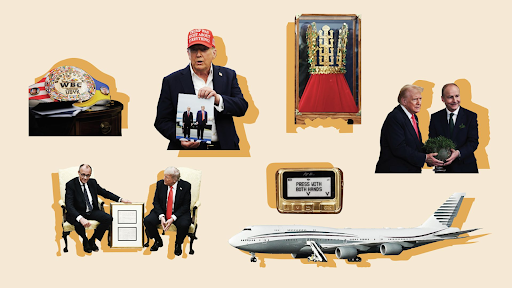
Photo: Duncan Senkumba, CNN
By Faith Kim ‘29
A golden samurai helmet. A World Boxing Championship belt. A golden crown. A golf club. A hand-painted portrait. A $400 million Boeing 747-8 luxury jetliner.
These are just some of the luxurious gifts given by foreign leaders to President Trump during his second term. It has been merely 10 months since his inauguration. Trump’s eagerness to trade policy for presents has set a dangerous precedent for American diplomacy. Foreign leaders are realizing favorable concessions need not be negotiated. They can be bought.
Though there is much public discourse on the legality of Trump’s acceptance of these gifts, the Constitution makes it pretty clear: this is illegal. Article I, Section 9, Clause 8 of the Constitution reads:
No Title of Nobility shall be granted by the United States: And no Person holding any Office of Profit or Trust under them, shall, without the Consent of the Congress, accept of any present, Emolument, Office, or Title, of any kind whatever, from any King, Prince, or foreign State.
This is the Foreign Emoluments Clause. It was introduced and unanimously approved during the Constitutional Convention to “prevent corruption” by “preserving foreign Ministers & other officers of the U.S. independent of external influence.” Though it does not explicitly include the office of the Presidency, it has been widely held — both in academia and in practice — that Presidents are subject to this clause.
In 1966, Congress built upon the Clause by passing the Foreign Gifts and Decorations Act, which provides general congressional consent for foreign gifts of minimal value (currently $480) and consent for gifts exceeding that value on the condition that it be deposited “for use and disposal as the property of the United States.”
The Foreign Emoluments Clause does not provide an enforcement mechanism. Nonetheless, past presidents have voluntarily complied with this law, making lack of enforcement unimportant. It is important to note that this is not, and has not, been a partisan issue. Presidents ranging from Andrew Jackson and Abraham Lincoln to Ronald Reagan and Barack Obama have sought Congressional approval for gifts or deposited them with federal agencies.
The Trump administration has broken precedent in many ways. He is the first American president to visit North Korea and meet with the sitting leader while in office. He is the first president to not only challenge birthright citizenship, but also threaten to denaturalize lawful citizens. He is the first president to withdraw from the Joint Comprehensive Plan of Action, a crucial agreement to limit the Iranian nuclear program. He is also the first president to openly accept lavish gifts that are mysteriously followed by foreign policy changes that are favourable to the gifting nation.
Since taking office in January, he has received gifts from Israel, Japan, Ukraine, Russia, Ireland, Canada, Qatar, South Africa, Germany, Scotland, the United Kingdom, Argentina, South Korea, and now, Swiss businessmen.
This is not to say that presidents should never accept gifts from foreign leaders. Nor is it to say that all foreign leaders give gifts with the expectation of favorable policies in return. Diplomatic gifts have long played a crucial role in cultivating relationships with foreign nations. “Gifts are a tangible expression of respect and understanding — a real bridge between nations,” said Capricia Marshall, chief diplomatic protocol officer during the Obama administration. In most cases, these gifts serve as reminders of the strong alliances forged between the United States and other nations, with the Statue of Liberty given by France being a famous example.
Gifts from foreign leaders only become dangerous when they go beyond expressing honor, welcome, and appreciation. They become dangerous when they are used as a bargaining chip — an instrument of flattery to extract concessions from the receiving nation.
On November 4th, Trump was gifted a 1kg personalized gold bar (worth $130,000) and a Rolex desktop clock by a delegation of Swiss industry tycoons. A mere 10 days later, the White House announced a trade deal that lowered tariffs on Swiss goods from 39% to 15%, in addition to Switzerland promising an investment of $200 billion in the U.S. This faced major backlash in Europe, with the president of the Swiss Green party remarking that the gifts showed how Trump’s “corrupt logic had poisoned the Swiss elite.”
On October 29th, Trump was gifted a replica of a historic golden crown by South Korean President Lee Jae Myung. The following day, the White House gave approval for South Korea to build nuclear submarines, which has been in discussion since 2017. Only 6 nations currently deploy nuclear submarines (United States, Russia, the United Kingdom, France, China, and India). Additionally, tariffs were lowered from 25% to 15%.
In May, Trump was gifted a $400 million luxury Boeing 747 to serve as the new Air Force One. Trump signed a security guarantee in September that made any attack on Qatar “a threat to the peace and security of the United States.” Soon after, an agreement was finalized in October for Qatar to build an air force training base in Idaho. These agreements are unprecedented for an Arab nation, with the BBC calling it an “extraordinary security pact … almost mirroring aspects of a Nato alliance.”
These are not isolated incidents. It is becoming the defining characteristic of American diplomacy. This is detrimental not only to our foreign relations but also to our democracy. At a time when public trust in government is already reaching historic lows, Trump’s quid-pro-quo foreign policy certainly does not restore our faith. Trump claims his foreign policy is “America First.” Yet, he has pocketed over $3.4 billion during his presidency according to The New Yorker. Meanwhile, 77% of Americans do not feel financially secure. It is becoming increasingly obvious that his policies are not “America First.” They are “Trump First.”
And who is Trump profiting off of? Everyday Americans, of course.
Axios estimates that the $400 million Qatari jet is worth 100x more than every other presidential gift from a foreign nation combined since 2001. Trump has repeatedly emphasized that this is a ‘free’ gift. It is not. Aviation experts have estimated refurbishing costs to be well over $400 million—closer to $1 billion, which will likely be funded by American taxpayers.
Volatile economic policy also has ripple effects across the globe. The World Trade Policy Uncertainty Index, created by the IMF, reached an all-time high in September, increasing nearly tenfold since Trump’s election. The UN Conference on Trade and Development notes that uncertainty leads to oscillating exchange rates, tightening capital flows, and rising borrowing costs, all of which hit small exporters and developing economies the hardest.
The losses don’t end there. Especially as executive power grows increasingly unchecked, foreign policy is becoming unilateral, essentially placing the lives of Americans at the whim of the president. When the commander-in-chief is someone who prioritizes personal wealth over national security, this becomes a significant issue. If the president continues to hand out security guarantees, major bailouts, and military technology to any foreign leader willing to shower him with presents and praise America’s status as a global power will be in jeopardy.
Foreign emoluments, as antiquated as the term sounds, will only grow in significance. With the advent of cryptocurrency and other digital currencies, large-value transfers are able to be made without the guardrails imposed by traditional financial institutions and regulations. In May, a UAE-based investment firm poured $2 billion into a stablecoin owned by the Trump family. Unlike flashy gifts, cryptocurrency allows foreign influence to be exerted out of the public eye, if desired.
Trump has made it clear that he will eschew established norms, and accepting foreign emoluments is no exception. Even worse, he has refused to report them as required by federal law. In 2023, the House Committee on Oversight and Accountability released a report showing that the Trump First Family failed to disclose over 100 foreign government gifts during his first term, totaling over $250,000. Additionally, in Trump v. United States (2024), the Supreme Court decided that presidents have presumptive immunity for all official actions, with constitutional powers granted absolute immunity, thus making regulation of foreign emoluments ever less tenable. As the current Supreme Court seems more than eager to appease him, Trump’s flagrant violations of the law show no sign of ending.
Secrecy, combined with a blatant refusal of transparency, is a dangerous concoction. Forget about American hegemony. Trump has ushered in an era of American bribery. And it is we, the people, who will suffer for it.